Los Angeles · Reports
The rise of the Los Angeles art scene, in charts
Seventy-five years of the city’s art world, counted: the galleries that opened and closed, the square feet they filled, the museums built, the prices paid, and how many of the world’s top-selling artists now have a gallery here.
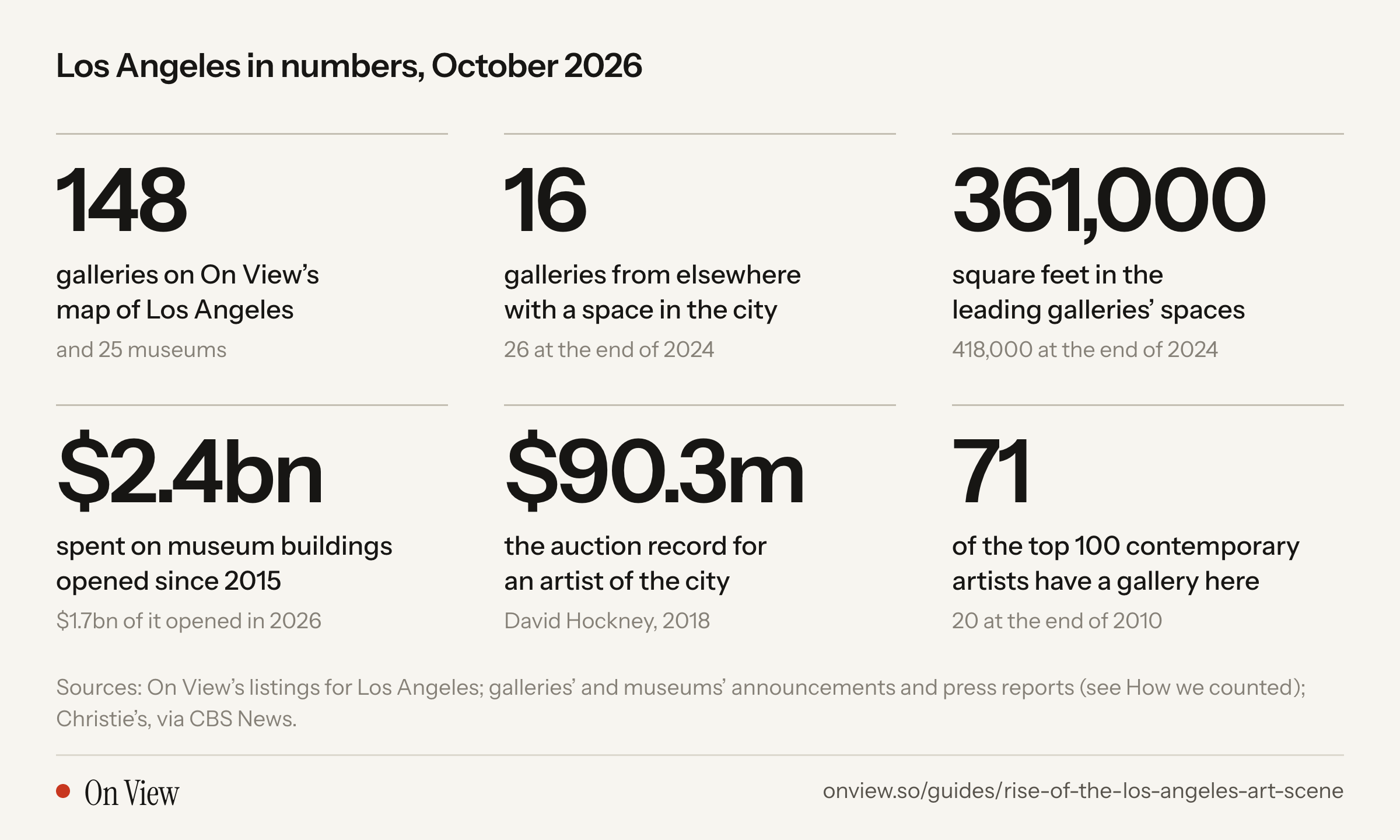
In 1957 the Los Angeles art world could fit on a block of La Cienega Boulevard. In October 2026 On View’s map of the city has 148 galleries and 25 museums; the county museum has just opened a $724 million building across Wilshire Boulevard; and 16 galleries with headquarters in New York, London, Paris, Berlin, Zurich and Lagos keep a space here.
This report counts how that happened. It follows 60 galleries from the year each opened in Los Angeles to the year it closed, measures the floor space of the largest, and sets beside them the museums, the art fairs and the auction prices of the same years. The short version: fifty years of slow building, a boom that began around 2012 and peaked in 2024, and a retreat since. At the end of 2024, 26 galleries from elsewhere had a space in Los Angeles. Today 16 do.
Every number here comes from a dated source: a gallery’s own announcement, its architect, a museum’s press office or a report in the art press, gathered in the first days of October 2026 and listed at the foot of the page, with how each chart was counted. Each chart can be linked to, downloaded or embedded, and has its numbers under it. For the galleries as they stand today, see the 12 best art galleries in Los Angeles and this month’s best shows.
Los Angeles in numbers
Los Angeles in numbers, October 2026
- galleries on On View’s map of Los Angeles
- 148
- and 25 museums
- galleries from elsewhere with a space in the city
- 16
- 26 at the end of 2024
- square feet in the leading galleries’ spaces
- 361,000
- 418,000 at the end of 2024
- spent on museum buildings opened since 2015
- $2.4bn
- $1.7bn of it opened in 2026
- the auction record for an artist of the city
- $90.3m
- David Hockney, 2018
- of the top 100 contemporary artists have a gallery here
- 71
- 20 at the end of 2010
Sources: On View’s listings for Los Angeles; galleries’ and museums’ announcements and press reports (see How we counted); Christie’s, via CBS News.
Seventy-five years on one timeline
The galleries came first. Felix Landau opened on La Cienega Boulevard in 1951 and Ferus in 1957, and by July 1963 Time magazine could count 22 exhibitions open on the boulevard on a single Monday night, the evening the dealers held their openings together. Ferus gave Andy Warhol his first solo show of Pop paintings in 1962, the 32 soup cans, and the next year Walter Hopps, one of its founders, organized Marcel Duchamp’s first retrospective at the Pasadena Art Museum. The county museum did not open on Wilshire Boulevard until 1965.
That first scene did not last. Ferus closed in 1966, Virginia Dwan’s gallery in Westwood in 1967 and Nicholas Wilder’s in 1979; Dwan and Wilder both went to New York. What followed was a move from district to district as rents and fashion changed: West Hollywood and Venice in the 1970s, Santa Monica and Bergamot Station in the 1990s, Chinatown from 1999, Culver City from 2003, Hollywood from 2012, downtown from 2013, and Melrose Hill, around David Zwirner’s block of Western Avenue, from 2021.
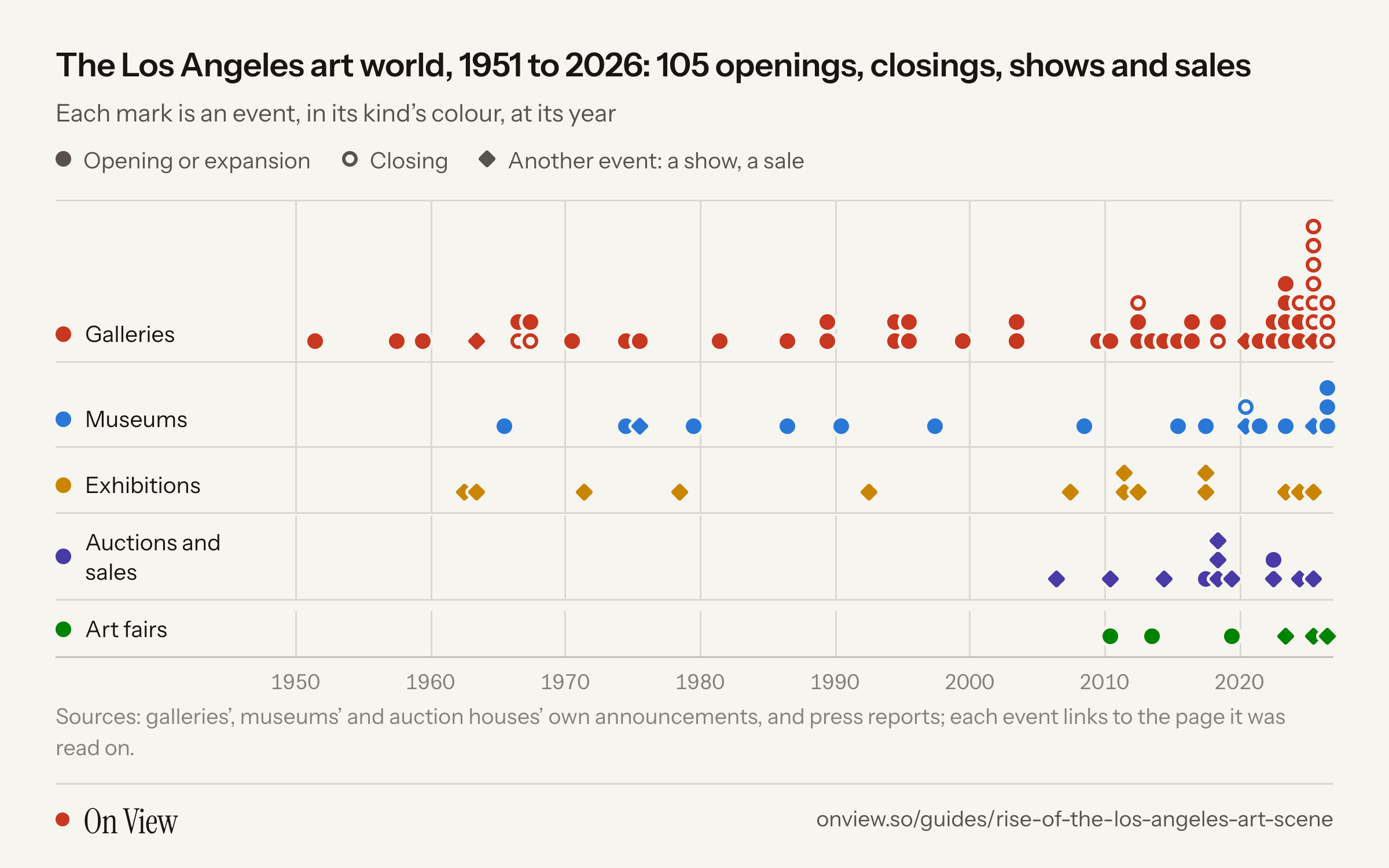
The timeline has 105 events of five kinds: galleries, museums, exhibitions, auctions and sales, and art fairs. The strip at its top shows where they fall: three in five of them come after 2010, and nearly half after 2016. A full dot is an opening or an expansion, a ring a closing, and a diamond anything else: a show, a sale, a fire. Of the 14 gallery closings marked, 10 have come since May 2024. Open a decade to read its events, each with the page it was read on.
The Los Angeles art world, 1951 to 2026: 105 openings, closings, shows and sales
Each mark is an event, in its kind’s colour, at its year
- Galleries
- Museums
- Exhibitions
- Auctions and sales
- Art fairs
- Opening or expansion
- Closing
- Another event: a show, a sale
1950s
3 eventsFelix Landau opens on La Cienega Boulevard The street becomes the city’s gallery row. (Galleries, opening) research.frick.org
Ferus Gallery opens The curator Walter Hopps and the artist Edward Kienholz start it on La Cienega; Irving Blum joins in 1958. (Galleries, opening) westernartandarchitecture.com
Virginia Dwan opens in Westwood Her gallery moves to a larger space there in 1962. (Galleries, opening) oac.cdlib.org
1960s
8 eventsWarhol’s soup cans at Ferus Andy Warhol’s first solo show of Pop paintings: the 32 Campbell’s Soup Cans. (Exhibitions) westernartandarchitecture.com
Duchamp’s first retrospective, in Pasadena Walter Hopps organizes it at the Pasadena Art Museum, with Marcel Duchamp there. (Exhibitions) nortonsimon.org
Monday nights on La Cienega Time counts 22 exhibitions open on the boulevard on one evening. (Galleries) time.com
LACMA opens on Wilshire Boulevard The county’s art museum, separate since 1961, gets its own campus. (Museums, opening) lacma.org
Ferus closes Irving Blum carries on for two years with New York’s Pace, as Ferus/Pace. (Galleries, closing) westernartandarchitecture.com
Gemini G.E.L. begins The artists’ print workshop on Melrose Avenue is still publishing. (Galleries, opening) geminigel.com
Dwan closes in Los Angeles Virginia Dwan had moved to New York in 1965; her gallery there runs to 1971. (Galleries, closing) lacma.org
Ace Gallery arrives from Vancouver Douglas Chrismas runs it in Los Angeles until a bankruptcy trustee removes him in 2016. (Galleries, opening) acegallery.net
1970s
8 eventsMargo Leavin opens in West Hollywood She stays for 42 years and more than 500 exhibitions. (Galleries, opening) oac.cdlib.org
Art and Technology at LACMA The results of a four-year program that put artists to work inside corporations. (Exhibitions) unframed.lacma.org
The Getty Villa opens J. Paul Getty’s museum, modeled on a Roman villa at Herculaneum. (Museums, opening) laconservancy.org
Larry Gagosian opens a print shop in Westwood Prints on Broxton turns to exhibitions the next year, as the Broxton Gallery. (Galleries, opening) gagosian.com
L.A. Louver opens in Venice Peter and Elizabeth Goulds’s gallery will show there for 50 years. (Galleries, opening) lalouver.com
The Pasadena Art Museum becomes the Norton Simon Facing bankruptcy after its 1969 building, it reopens with Norton Simon’s collection. (Museums) nortonsimon.org
Treasures of Tutankhamun at LACMA About 1.3 million visitors in four months. (Exhibitions) beverlypress.com
MOCA is founded It opens in a warehouse, the Temporary Contemporary, in 1983. (Museums, opening) moca.org
1980s
5 eventsGagosian opens on Almont Drive He moves to Robertson Boulevard in 1982, and by 1985 has a space in New York too. (Galleries, opening) gagosian.com
Ace takes a floor of the Wilshire Tower 30,000 square feet on the Miracle Mile. (Galleries, opening) acegallery.net
MOCA opens on Grand Avenue Arata Isozaki’s building, downtown. (Museums, opening) libraries.usc.edu
Stuart Regen Gallery opens in West Hollywood It becomes Regen Projects in 1993. (Galleries, opening) theartnewspaper.com
Luhring Augustine Hetzler opens in Santa Monica A joint branch of a New York and a Cologne gallery; it closes in February 1992. (Galleries, opening) luhringaugustine.com
1990s
8 eventsThe Hammer Museum opens in Westwood UCLA takes over its management in 1994. (Museums, opening) en.wikipedia.org
Helter Skelter at MOCA Paul Schimmel’s show of 16 Los Angeles artists, subtitled L.A. Art in the 1990s. (Exhibitions) moca.org
Blum & Poe opens in Santa Monica ACME. and Marc Foxx open there the same year. (Galleries, opening) theartnewspaper.com
Bergamot Station opens A five-acre complex of galleries on a former rail and factory site in Santa Monica. (Galleries, opening) bergamotstation.com
Gagosian returns, to Beverly Hills A building by Richard Meier on Camden Drive, opening with Frank Stella. (Galleries, opening) gagosian.com
PaceWildenstein opens in Beverly Hills New York’s Pace stays until 2000. (Galleries, opening) pacegallery.com
The Getty Center opens Richard Meier’s $1.3 billion campus above Brentwood, free from the first day. (Museums, opening) pbssocal.org
China Art Objects opens in Chinatown The first gallery on Chung King Road, in a $500-a-month basement. (Galleries, opening) phaidon.com
2000s
6 eventsBlum & Poe moves to Culver City Dozens of galleries follow, making the Culver City Arts District. (Galleries, opening) eschergunewardena.com
David Kordansky opens in Chinatown Part of the neighborhood’s second wave of galleries. (Galleries, opening) davidkordanskygallery.com
David Geffen sells a Pollock and a de Kooning In private sales: No. 5, 1948 for a reported $140 million and Woman III for $137.5 million. (Auctions and sales) worldart.news
©Murakami at MOCA More than 90 works and a working Louis Vuitton shop; 149,323 visitors. (Exhibitions) huffpost.com
The Broad Contemporary Art Museum opens at LACMA A $56 million building by Renzo Piano. (Museums, opening) www-images.lacma.org
Blum & Poe’s 21,000 square feet The gallery crosses La Cienega Boulevard into a converted factory. (Galleries, opening) eschergunewardena.com
2010s
28 eventsArt Los Angeles Contemporary begins The city’s contemporary fair for a decade, at Santa Monica Airport. (Art fairs, opening) theartnewspaper.com
A Los Angeles collection sets the auction record Picasso’s Nude, Green Leaves and Bust, from the Brody collection, sells for $106.5 million at Christie’s in New York. (Auctions and sales) en.wikipedia.org
L&M Arts opens in Venice The New York gallery converts a 1930s power station; it closes in August 2013. (Galleries, opening) why-site.com
Art in the Streets at MOCA 201,352 visitors, the most for any exhibition in MOCA’s history. (Exhibitions) moca.org
Pacific Standard Time The Getty’s program on art in Los Angeles from 1945 to 1980: 68 exhibitions and about 1.8 million visits. (Exhibitions) getty.edu
Matthew Marks opens in West Hollywood The New York gallery builds new, with an Ellsworth Kelly on the facade. (Galleries, opening) fineartpublicity.com
The first Made in L.A. The Hammer’s biennial of the city’s artists opens with 60 of them. (Exhibitions) hammer.ucla.edu
Regen Projects moves to Hollywood A 20,000-square-foot building by Michael Maltzan starts a gallery district at Highland Avenue. (Galleries, opening) laweekly.com
Margo Leavin closes After nearly 42 years. (Galleries, closing) oac.cdlib.org
Night Gallery and François Ghebaly move downtown The first big galleries in what LA Weekly calls an industrial no man’s land. (Galleries, opening) laweekly.com
Paris Photo Los Angeles Three editions on the Paramount lot; the fourth is cancelled for weak sales. (Art fairs, opening) theartnewspaper.com
David Kordansky moves to Mid-City 13,000 square feet off La Brea Avenue, made from a martial-arts studio and a car repair shop. (Galleries, opening) why-site.com
Ed Ruscha’s Smash: $30.4 million At Christie’s; his top price will more than double in the next ten years. (Auctions and sales) heni.com
The Broad opens Eli and Edythe Broad’s $140 million museum on Grand Avenue, free; 820,000 visitors in its first year. (Museums, opening) thebroad.org
Maccarone opens in Boyle Heights The New York gallery takes 35,000 square feet on Mission Road. (Galleries, opening) theartnewspaper.com
Sprüth Magers opens across from LACMA The Berlin gallery takes a 1971 building by William Pereira’s firm on Wilshire Boulevard. (Galleries, opening) wallpaper.com
Hauser Wirth & Schimmel opens All 116,000 square feet of a former flour mill in the Arts District. (Galleries, opening) architecturalrecord.com
Christie’s opens a Beverly Hills flagship 4,500 square feet, with no auctions planned there. (Auctions and sales, opening) theartnewspaper.com
The Marciano Art Foundation opens In a former Masonic temple on Wilshire Boulevard; ICA LA opens in the Arts District the same year. (Museums, opening) timeout.com
Pacific Standard Time: LA/LA Latin American and Latino art at more than 70 institutions; nearly 2.8 million visits. (Exhibitions) getty.edu
Yayoi Kusama: Infinity Mirrors at The Broad The first 50,000 tickets sell out in under two hours. (Exhibitions) artsbeatla.com
Mark Bradford’s Helter Skelter I: $12 million At Phillips in London, then the most paid at auction for a living African American artist. (Auctions and sales) culturetype.com
Kerry James Marshall’s Past Times: $21.1 million The painter was raised in South Los Angeles and trained at Otis. (Auctions and sales) theartnewspaper.com
356 Mission closes Laura Owens’s space in Boyle Heights, after sustained protests against galleries in the neighborhood. (Galleries, closing) hyperallergic.com
Jeffrey Deitch opens in Hollywood A 15,000-square-foot warehouse converted by Frank Gehry, opening with Ai Weiwei. (Galleries, opening) galeriemagazine.com
David Hockney’s $90.3 million Portrait of an Artist (Pool with Two Figures) at Christie’s in New York: then the record for a living artist. (Auctions and sales) cbsnews.com
The first Frieze Los Angeles 70 galleries on the Paramount lot, and about 30,000 visitors; Felix opens the same week. (Art fairs, opening) culturetype.com
Ruscha’s Hurting the Word Radio #2: $52.5 million At Christie’s in New York. (Auctions and sales) heni.com
2020s
39 eventsMOCA becomes free On a $10 million gift; the Hammer has been free since 2014. (Museums) abc7.com
LACMA begins demolishing its old buildings Four of them, to make way for Peter Zumthor’s. (Museums, closing) laconservancy.org
Gallery Platform LA With their doors shut by the pandemic, about 80 galleries start a shared website. (Galleries) hyperallergic.com
Karma opens in West Hollywood One of six galleries from elsewhere to open in the city that year. (Galleries, opening) artdealers.org
The Academy Museum opens Renzo Piano’s $482 million museum of the movies, next to LACMA. (Museums, opening) cbsnews.com
Pace returns, by taking over Kayne Griffin And with it the gallery on South La Brea Avenue, with its Turrell Skyspace. (Galleries, opening) pacegallery.com
Ernie Barnes’s The Sugar Shack: $15.3 million Against an estimate of $150,000 to $200,000. (Auctions and sales) culturetype.com
Sean Kelly opens in Hollywood 10,000 square feet on Highland Avenue. (Galleries, opening) skny.com
Phillips opens in West Hollywood A gallery for previews and selling exhibitions. (Auctions and sales, opening) phillips.com
Frieze moves to Santa Monica Airport 124 galleries, its largest edition. (Art fairs) theartnewspaper.com
Hauser & Wirth opens in West Hollywood A second gallery, in a 1931 car showroom. (Galleries, opening) wehotimes.com
The Hammer finishes its expansion Twenty years of work by Michael Maltzan, and 60% more gallery space. (Museums, opening) newsroom.ucla.edu
Lisson opens in Hollywood The London gallery, on Sycamore Avenue. (Galleries, opening) lissongallery.com
David Zwirner opens in Melrose Hill In two former prop shops on Western Avenue; a district grows around it. (Galleries, opening) culturedmag.com
Keith Haring at The Broad 171,000 visitors, the museum’s most for a special exhibition. (Exhibitions) thebroad.org
Marian Goodman opens in Hollywood 13,000 square feet by Johnston Marklee, opening with Steve McQueen. (Galleries, opening) mariangoodman.com
Perrotin opens in Mid-City The Paris gallery, during Frieze week. (Galleries, opening) hypebeast.com
Zwirner’s third building A new three-story gallery brings its block of Western Avenue to 30,000 square feet. (Galleries, opening) artnowla.com
Nino Mier closes his four Los Angeles galleries Three weeks after former staff said the gallery had underpaid artists. (Galleries, closing) artefuse.com
PST ART: Art & Science Collide The third Pacific Standard Time: 67 exhibitions and, the Getty says, 4 million visits. (Exhibitions) getty.edu
Ruscha’s Standard Station: $68.3 million Standard Station, Ten-Cent Western Being Torn in Half (1964), at Christie’s in New York: his record. (Auctions and sales) en.thevalue.com
The Palisades and Eaton fires Artists, dealers and collectors lose homes, studios and collections; the Getty Villa closes until June. (Galleries) theartnewspaper.com
Frieze goes ahead, six weeks after the fires With 97 galleries. (Art fairs) theartnewspaper.com
The Broad breaks ground on its expansion $100 million and 70% more gallery space, due in 2028. (Museums) theartnewspaper.com
Blum says it will close Tim Blum ends the gallery he founded with Jeff Poe in 1994: “This is not about the market. This is about the system.” (Galleries, closing) theartnewspaper.com
Clearing closes In New York and Los Angeles on the same day. (Galleries, closing) theartnewspaper.com
Tanya Bonakdar closes in Hollywood After seven years, at the end of its lease. (Galleries, closing) theartnewspaper.com
L.A. Louver closes its doors to the public After 50 years in Venice, it turns to private dealing. (Galleries, closing) theartnewspaper.com
MONUMENTS at MOCA and The Brick Curated by Hamza Walker, Kara Walker and Bennett Simpson; it runs to May 2026. (Exhibitions) moca.org
Sean Kelly ends public exhibitions in Los Angeles Three years after opening; the space is now by appointment. (Galleries, closing) apollo-magazine.com
Hockney’s Isherwood and Bachardy: $44.3 million His 1968 double portrait: the most paid for one of his Los Angeles pictures. (Auctions and sales) heni.com
Southern Guild leaves for New York The Cape Town gallery had opened in Melrose Hill in February 2024. (Galleries, closing) theartnewspaper.com
Frieze Los Angeles, seventh edition About 100 galleries and 32,000 visitors at Santa Monica Airport. (Art fairs) artdependence.com
Michael Werner’s Beverly Hills gallery has closed Less than two years after it opened. (Galleries, closing) culturedmag.com
LACMA’s David Geffen Galleries open Peter Zumthor’s building over Wilshire Boulevard: $724 million, and 110,000 square feet of galleries. (Museums, opening) architecturalrecord.com
Marian Goodman’s last Los Angeles show closes Tacita Dean’s; the gallery now lists only New York and Paris. (Galleries, closing) mariangoodman.com
The Box says it will close After 19 years, in Chinatown and then the Arts District. (Galleries, closing) hyperallergic.com
Dataland opens Refik Anadol and Efsun Erkılıç’s “museum of AI arts”, at The Grand LA downtown. (Museums, opening) related.com
The Lucas Museum of Narrative Art opens 300,000 square feet in Exposition Park, with more than 1,300 works on view. (Museums, opening) lucasmuseum.org
Sources: galleries’, museums’ and auction houses’ own announcements, and press reports; each event links to the page it was read on.
The galleries: who came, who stayed, who left
For most of its history, a Los Angeles gallery was a local business. The exceptions were brief. Ferus merged with New York’s Pace for two years after 1966; Luhring Augustine of New York and Max Hetzler of Cologne ran a joint gallery in Santa Monica from 1989 to 1992; Pace opened in Beverly Hills in 1995 and left in 2000. Larry Gagosian, who had started with a print shop in Westwood in 1974 and moved to New York in the 1980s, came back in 1995 with a building by Richard Meier in Beverly Hills. For the rest of the 2000s his was the only gallery from elsewhere on this chart.
Galleries from elsewhere in Los Angeles: one in 2009, 26 in 2024, 16 today
Galleries based in another city with a space open to the public in Los Angeles County at the end of each year (2026: on October 3)
The numbers
| Year | Galleries from elsewhere with a Los Angeles space |
|---|---|
| 1989 | 1 |
| 1990 | 1 |
| 1991 | 1 |
| 1992 | 0 |
| 1993 | 0 |
| 1994 | 0 |
| 1995 | 2 |
| 1996 | 2 |
| 1997 | 2 |
| 1998 | 2 |
| 1999 | 2 |
| 2000 | 1 |
| 2001 | 1 |
| 2002 | 1 |
| 2003 | 1 |
| 2004 | 1 |
| 2005 | 1 |
| 2006 | 1 |
| 2007 | 1 |
| 2008 | 1 |
| 2009 | 1 |
| 2010 | 2 |
| 2011 | 2 |
| 2012 | 3 |
| 2013 | 2 |
| 2014 | 5 |
| 2015 | 8 |
| 2016 | 10 |
| 2017 | 8 |
| 2018 | 10 |
| 2019 | 9 |
| 2020 | 10 |
| 2021 | 15 |
| 2022 | 19 |
| 2023 | 26 |
| 2024 | 26 |
| 2025 | 19 |
| 2026 | 16 |
Eight galleries with no closing date on record are counted to the end of the last year a source shows them open. Source: On View, from the galleries’ announcements and press reports of 38 galleries’ openings and closings.
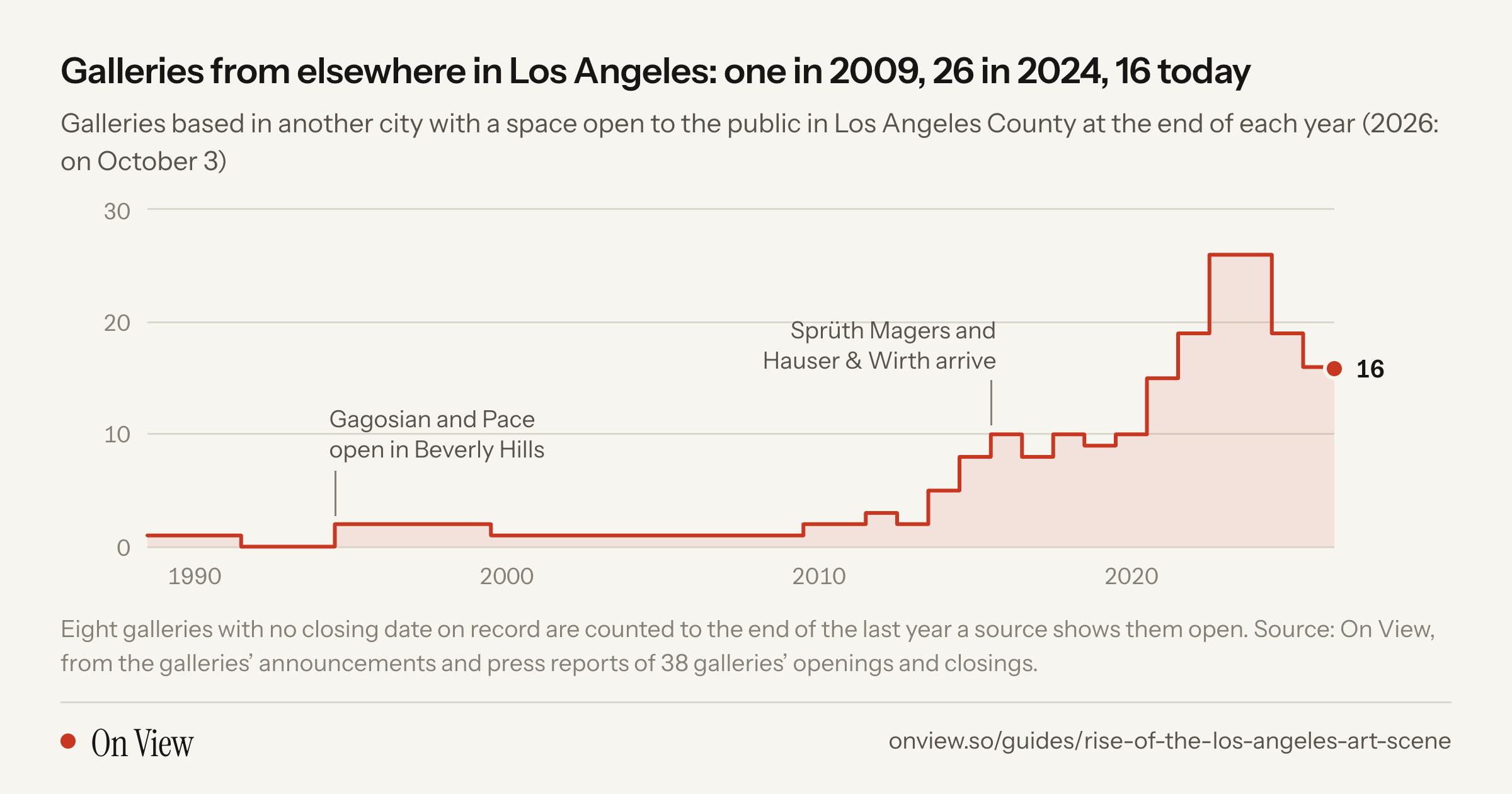
That changed in 2010. L&M Arts came from New York that year and Matthew Marks in 2012, and six more arrived in 2014 and 2015, among them Maccarone, with 35,000 square feet in Boyle Heights. In February and March 2016 Sprüth Magers of Berlin and Hauser & Wirth of Zurich opened within three weeks of each other, and the rest followed: Jeffrey Deitch and Tanya Bonakdar in 2018, Karma in 2021, Pace, again, and Sean Kelly in 2022, Lisson, David Zwirner and Marian Goodman in 2023, Perrotin and Michael Werner in 2024. Twenty galleries from elsewhere opened in Los Angeles between 2021 and 2024, and at the end of 2023 and of 2024, 26 had a space here.
Then they began to leave. Nino Mier, who had grown from one gallery in West Hollywood to four, closed them all in May 2024, three weeks after a report that the gallery had underpaid artists; Praz-Delavallade of Paris went that July. In January 2025 the Palisades and Eaton fires burned the homes and studios of artists, dealers and collectors. From that July, in five months, Blum (the former Blum & Poe, founded in 1994), Clearing, Tanya Bonakdar, The Hole, Sean Kelly and Southern Guild closed or stopped showing, and L.A. Louver, in Venice since 1975, turned to private dealing. Michael Werner and Marian Goodman followed early in 2026, and The Box, after 19 years, that June.
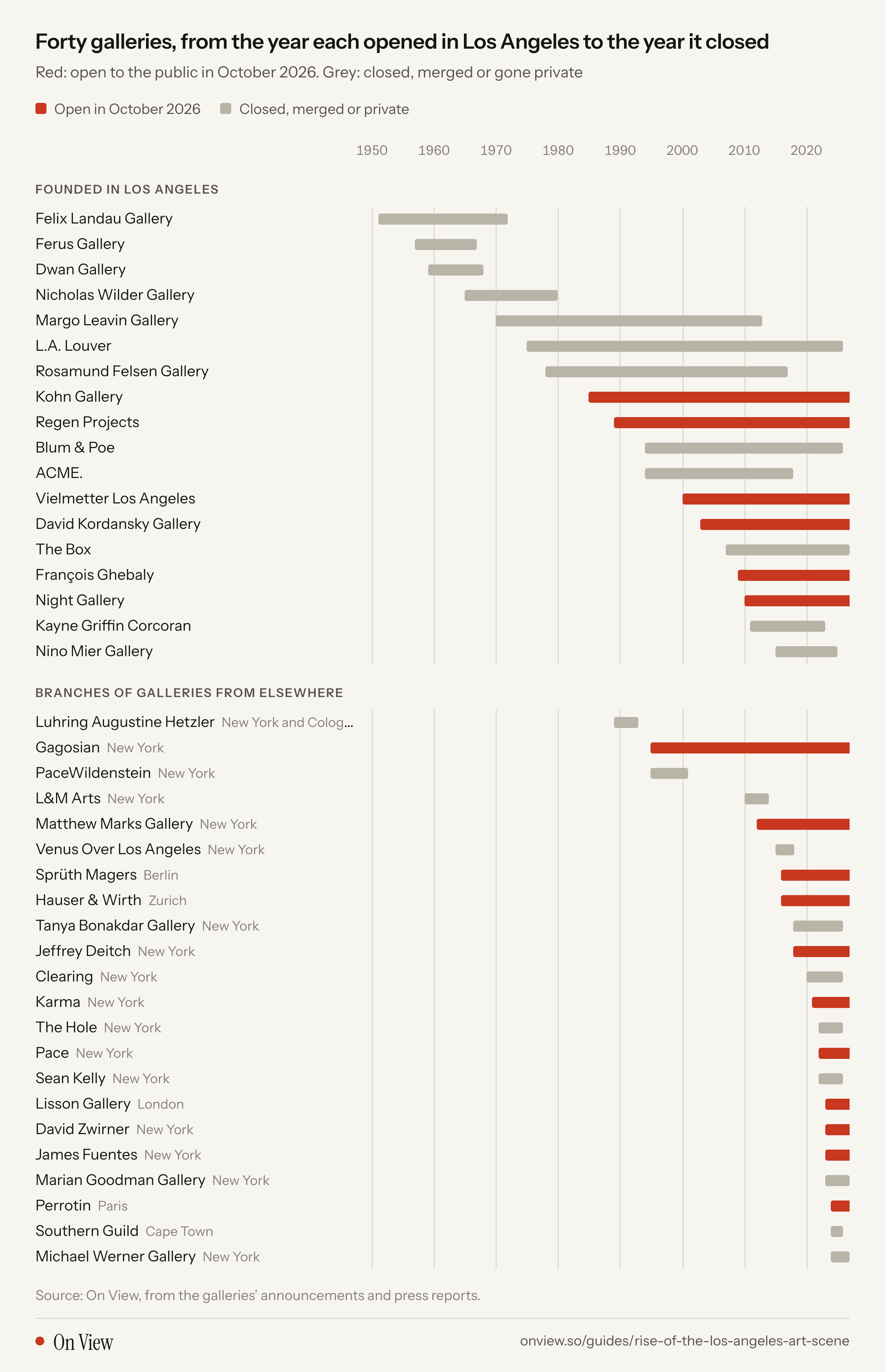
Forty galleries, from the year each opened in Los Angeles to the year it closed
Red: open to the public in October 2026. Grey: closed, merged or gone private
- Open in October 2026
- Closed, merged or private
Founded in Los Angeles
- Felix Landau Gallery
- Ferus Gallery
- Dwan Gallery
- Nicholas Wilder Gallery
- Margo Leavin Gallery
- L.A. Louver
- Rosamund Felsen Gallery
- Kohn Gallery
- Regen Projects
- Blum & Poe
- ACME.
- Vielmetter Los Angeles
- David Kordansky Gallery
- The Box
- François Ghebaly
- Night Gallery
- Kayne Griffin Corcoran
- Nino Mier Gallery
Branches of galleries from elsewhere
- Luhring Augustine HetzlerNew York and Cologne
- GagosianNew York
- PaceWildensteinNew York
- L&M ArtsNew York
- Matthew Marks GalleryNew York
- Venus Over Los AngelesNew York
- Sprüth MagersBerlin
- Hauser & WirthZurich
- Tanya Bonakdar GalleryNew York
- Jeffrey DeitchNew York
- ClearingNew York
- KarmaNew York
- The HoleNew York
- PaceNew York
- Sean KellyNew York
- Lisson GalleryLondon
- David ZwirnerNew York
- James FuentesNew York
- Marian Goodman GalleryNew York
- PerrotinParis
- Southern GuildCape Town
- Michael Werner GalleryNew York
The numbers
| Gallery | Where it is from | From | To |
|---|---|---|---|
| Felix Landau Gallery | Founded in Los Angeles | 1951 | 1971 |
| Ferus Gallery | Founded in Los Angeles | 1957 | 1966 |
| Dwan Gallery | Founded in Los Angeles | 1959 | 1967 |
| Nicholas Wilder Gallery | Founded in Los Angeles | 1965 | 1979 |
| Margo Leavin Gallery | Founded in Los Angeles | 1970 | 2012 |
| L.A. Louver | Founded in Los Angeles | 1975 | 2025 |
| Rosamund Felsen Gallery | Founded in Los Angeles | 1978 | 2016 |
| Kohn Gallery | Founded in Los Angeles | 1985 | Open |
| Regen Projects | Founded in Los Angeles | 1989 | Open |
| Blum & Poe | Founded in Los Angeles | 1994 | 2025 |
| ACME. | Founded in Los Angeles | 1994 | 2017 |
| Vielmetter Los Angeles | Founded in Los Angeles | 2000 | Open |
| David Kordansky Gallery | Founded in Los Angeles | 2003 | Open |
| The Box | Founded in Los Angeles | 2007 | 2026 |
| François Ghebaly | Founded in Los Angeles | 2009 | Open |
| Night Gallery | Founded in Los Angeles | 2010 | Open |
| Kayne Griffin Corcoran | Founded in Los Angeles | 2011 | 2022 |
| Nino Mier Gallery | Founded in Los Angeles | 2015 | 2024 |
| Luhring Augustine Hetzler, New York and Cologne | Branches of galleries from elsewhere | 1989 | 1992 |
| Gagosian, New York | Branches of galleries from elsewhere | 1995 | Open |
| PaceWildenstein, New York | Branches of galleries from elsewhere | 1995 | 2000 |
| L&M Arts, New York | Branches of galleries from elsewhere | 2010 | 2013 |
| Matthew Marks Gallery, New York | Branches of galleries from elsewhere | 2012 | Open |
| Venus Over Los Angeles, New York | Branches of galleries from elsewhere | 2015 | 2017 |
| Sprüth Magers, Berlin | Branches of galleries from elsewhere | 2016 | Open |
| Hauser & Wirth, Zurich | Branches of galleries from elsewhere | 2016 | Open |
| Tanya Bonakdar Gallery, New York | Branches of galleries from elsewhere | 2018 | 2025 |
| Jeffrey Deitch, New York | Branches of galleries from elsewhere | 2018 | Open |
| Clearing, New York | Branches of galleries from elsewhere | 2020 | 2025 |
| Karma, New York | Branches of galleries from elsewhere | 2021 | Open |
| The Hole, New York | Branches of galleries from elsewhere | 2022 | 2025 |
| Pace, New York | Branches of galleries from elsewhere | 2022 | Open |
| Sean Kelly, New York | Branches of galleries from elsewhere | 2022 | 2025 |
| Lisson Gallery, London | Branches of galleries from elsewhere | 2023 | Open |
| David Zwirner, New York | Branches of galleries from elsewhere | 2023 | Open |
| James Fuentes, New York | Branches of galleries from elsewhere | 2023 | Open |
| Marian Goodman Gallery, New York | Branches of galleries from elsewhere | 2023 | 2026 |
| Perrotin, Paris | Branches of galleries from elsewhere | 2024 | Open |
| Southern Guild, Cape Town | Branches of galleries from elsewhere | 2024 | 2025 |
| Michael Werner Gallery, New York | Branches of galleries from elsewhere | 2024 | 2026 |
Source: On View, from the galleries’ announcements and press reports.
Few of them blamed Los Angeles. Tim Blum said it was the system, not the market; Tanya Bonakdar’s lease had ended; Southern Guild moved to New York. But the years coincide with a falling market, in which global art sales dropped 12% in 2024 by Art Basel and UBS’s count, and with the cost of running a second gallery a continent from the first. Only The Box, whose founder’s family lost homes in the Eaton fire, named the fires among its reasons. The membership of Gallery Platform LA, the galleries’ own association, tells the same story from the other side: 124 galleries and museums in March 2024, 96 today.
The galleries that grew up in the city have held on better than the visitors. Regen Projects, David Kordansky, Vielmetter, François Ghebaly and Night Gallery have each moved to a larger building or added one since 2012, and are still in them. So have the largest of the arrivals: Hauser & Wirth, David Zwirner, Gagosian, Pace, Sprüth Magers, which marked ten years on Wilshire Boulevard this summer, Lisson, Perrotin, Jeffrey Deitch and Karma.
The space: from 50,000 square feet to 418,000
Floor space is the plainest measure of what the galleries have committed to the city. Counting the spaces whose size was reported when they opened (39 of them, at 33 galleries), the leading galleries had about 50,000 square feet between them in 2000, of which 30,000 was Ace Gallery’s floor of the Wilshire Tower. By 2010 they had 108,000. Then Regen Projects built 20,000 square feet in Hollywood (2012), David Kordansky 13,000 in Mid-City (2014) and Maccarone 35,000 in Boyle Heights (2015).
The leading galleries’ floor space grew eightfold in 24 years, then fell by a seventh
Reported floor area, in square feet, of 39 gallery spaces open at the end of each year (2026: on October 3)
The numbers
| Year | Square feet |
|---|---|
| 2000 | 49,600 |
| 2001 | 49,600 |
| 2002 | 49,600 |
| 2003 | 71,600 |
| 2004 | 71,600 |
| 2005 | 71,600 |
| 2006 | 71,600 |
| 2007 | 75,400 |
| 2008 | 75,400 |
| 2009 | 91,400 |
| 2010 | 107,900 |
| 2011 | 107,900 |
| 2012 | 123,600 |
| 2013 | 141,600 |
| 2014 | 174,100 |
| 2015 | 197,100 |
| 2016 | 310,100 |
| 2017 | 288,600 |
| 2018 | 303,600 |
| 2019 | 320,100 |
| 2020 | 330,100 |
| 2021 | 308,100 |
| 2022 | 350,850 |
| 2023 | 390,550 |
| 2024 | 418,050 |
| 2025 | 374,050 |
| 2026 | 361,050 |
Spaces with no reported size are left out, so the totals are a floor. Source: On View, from figures given by the galleries, their architects and the press when each space opened.
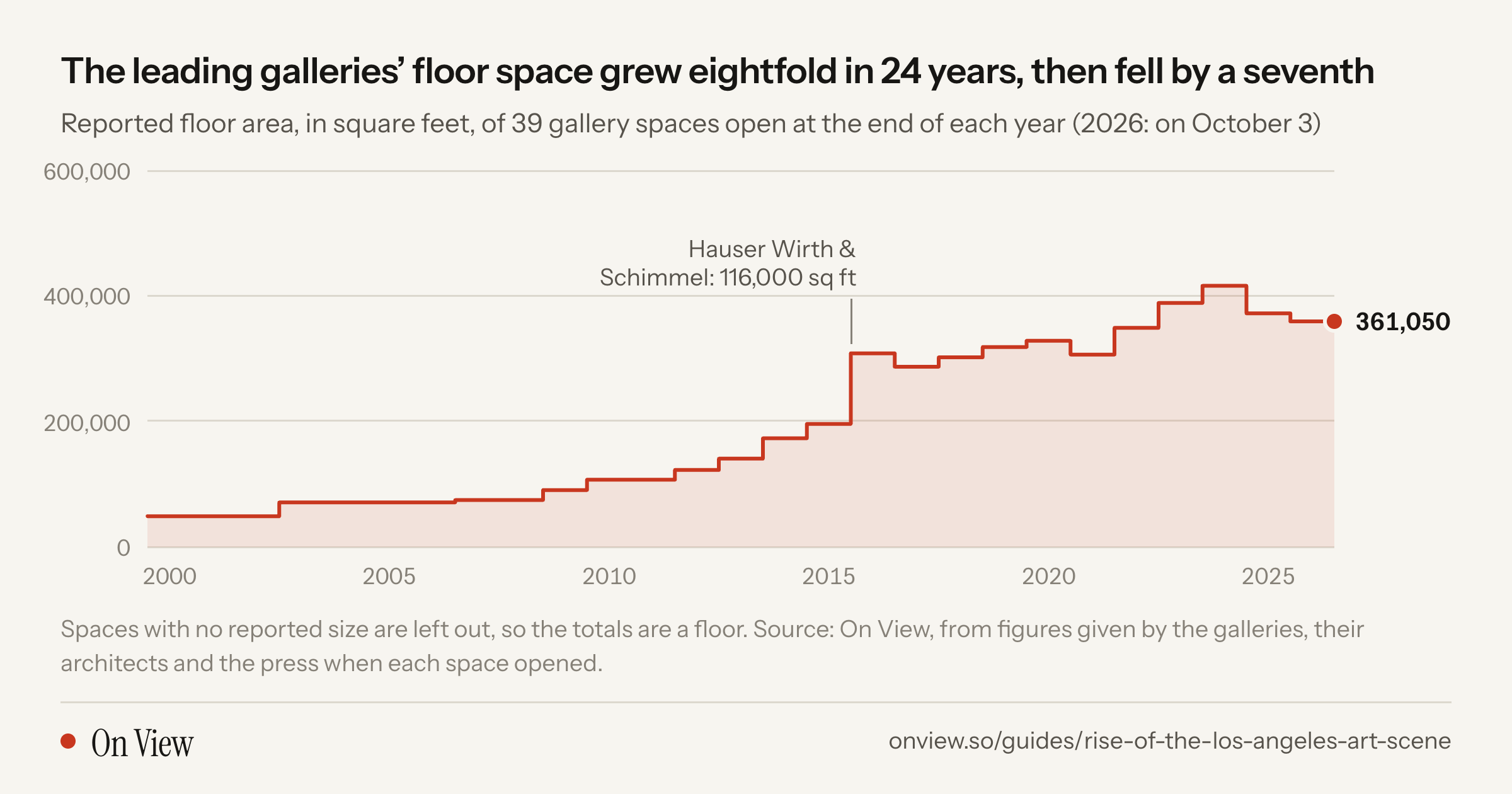
In March 2016 Hauser Wirth & Schimmel opened in all 116,000 square feet of a former flour mill in the Arts District: more than every gallery on this chart had put together six years before. The total passed 300,000 square feet that year and reached 418,000 at the end of 2024, more than eight times the figure for 2000. It has since fallen by 57,000 square feet, about a seventh, with the closing of Blum, Marian Goodman, Sean Kelly, The Hole and Southern Guild.
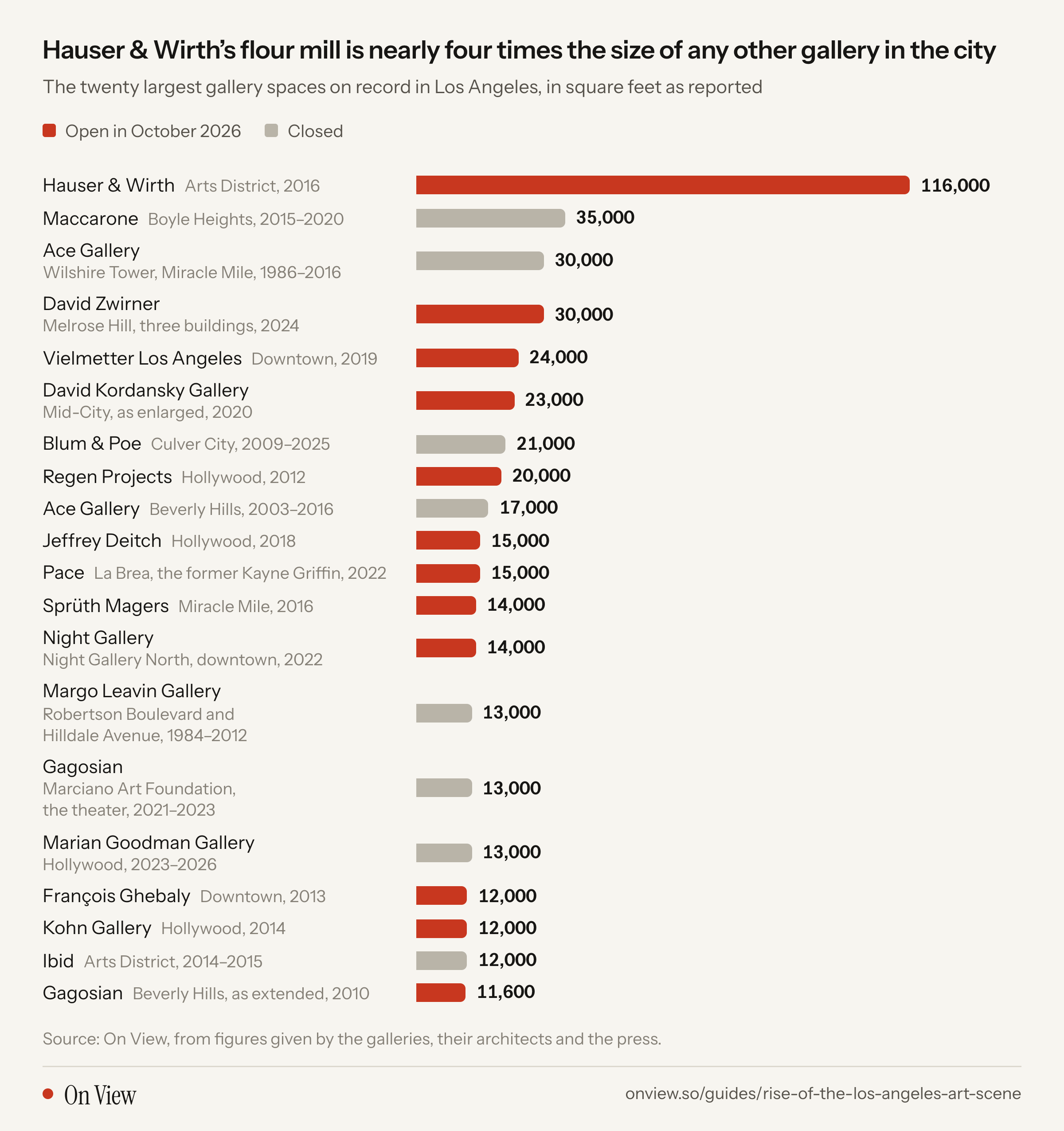
Gagosian, the first of the large galleries to come, has never been among the largest. Richard Meier’s building for it in Beverly Hills had 6,600 square feet when it opened in 1995 and has had 11,600 since an extension in 2010; from 2021 to 2023 the gallery also showed in the 13,000-square-foot theater of the Marciano Art Foundation, a former Masonic temple on Wilshire Boulevard.
These are reported figures, and of different kinds. Hauser & Wirth’s is the whole complex, with its restaurant, garden and bookshop; David Zwirner’s 30,000 square feet is three buildings on one block. Several large galleries have never given a size (Karma, Tanya Bonakdar and Michael Werner among them), so the totals are a floor. What the buildings were before says as much about the city: a flour mill, a bank, two car showrooms, a power station, a pair of prop shops, a film-storage vault, a body shop and a yoga studio.
The artists: how many of the top 100 have a gallery here
One test of a city’s place in the market is to ask of the artists who sell for the most: how many have a gallery there? We took two published rankings. The Hiscox Artist Top 100 ranks contemporary artists by what their work made since 2000 sold for at auction in 2024. The Artprice100 is the hundred artists whose work sold for the most at auction over the five years to 2024; 91 of them were born after 1860, and those are the ones counted here.
Of the Hiscox hundred, 71 are on the roster of a gallery with a space open in Los Angeles today. Gagosian has 22 of them, Hauser & Wirth 13 and David Zwirner 11. Counting each artist from the year they joined such a gallery, or from the year it opened here if that came later, 11 of the hundred had a gallery in the city at the end of 2000, 20 at the end of 2010 and 27 at the end of 2015. Hauser & Wirth and Sprüth Magers took it to 32 in 2016. The largest step came when Pace, David Zwirner, Lisson and Marian Goodman opened: from 45 at the end of 2021 to 66 two years later, and 72 the year after that, when Perrotin arrived. The closures since have cost it little, because nearly all the artists concerned have a second gallery in the city.
Seven in ten of the top 100 contemporary artists now have a gallery in Los Angeles. In 2000, one in ten did
Share of the artists on two rankings whose gallery had a space open in Los Angeles at the end of each year (2026: on October 3)
- Top 100 contemporary artists (Hiscox)
- Top-selling modern and contemporary artists (Artprice100)
The numbers
| Year | Top 100 contemporary artists (Hiscox) | Top-selling modern and contemporary artists (Artprice100) |
|---|---|---|
| 2000 | 11% | 13% |
| 2001 | 12% | 14% |
| 2002 | 12% | 14% |
| 2003 | 13% | 15% |
| 2004 | 14% | 15% |
| 2005 | 14% | 15% |
| 2006 | 17% | 18% |
| 2007 | 17% | 18% |
| 2008 | 18% | 18% |
| 2009 | 19% | 19% |
| 2010 | 20% | 18% |
| 2011 | 22% | 19% |
| 2012 | 25% | 20% |
| 2013 | 25% | 21% |
| 2014 | 26% | 21% |
| 2015 | 27% | 21% |
| 2016 | 32% | 31% |
| 2017 | 33% | 31% |
| 2018 | 35% | 31% |
| 2019 | 40% | 32% |
| 2020 | 40% | 32% |
| 2021 | 45% | 31% |
| 2022 | 52% | 40% |
| 2023 | 66% | 45% |
| 2024 | 72% | 46% |
| 2025 | 72% | 46% |
| 2026 | 71% | 46% |
An artist is counted from the year they joined the gallery, or first showed with it, and not before it had a space here. Rosters are today’s, so an earlier gallery an artist has left is mostly not counted. Sources: Hiscox Artist Top 100 (2025 edition); Artprice100 (2025 composition, the 91 artists born since 1860); the galleries’ rosters as read in October 2026.
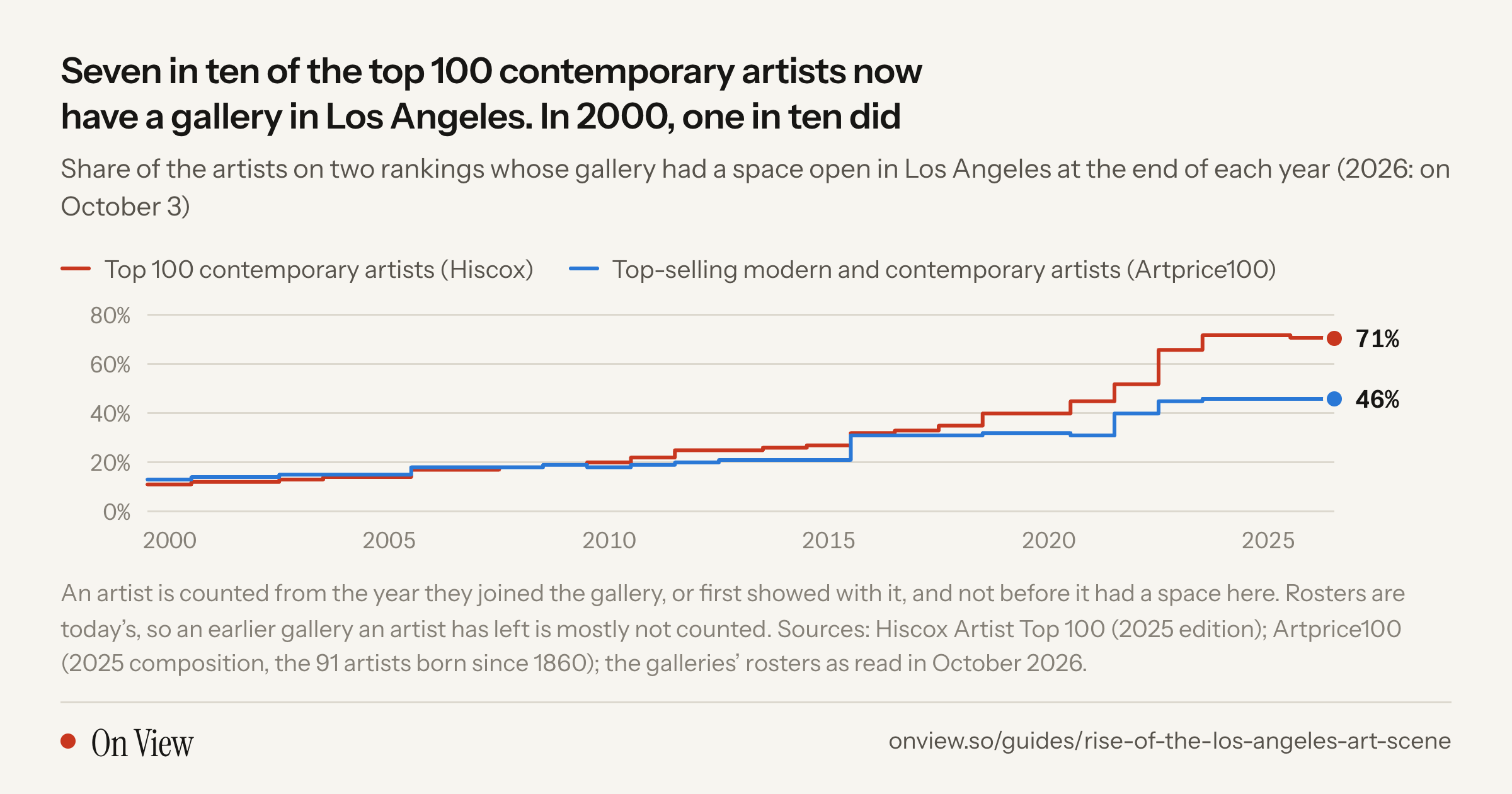
The Artprice list gives a lower share, 42 of 91, and for a reason that has little to do with Los Angeles: the rest of that list is mostly modern painters long dead, from Magritte and Chagall to Matisse, and the ink painters who lead the Chinese market, such as Qi Baishi and Fu Baoshi. No gallery here represents them, and few anywhere do.
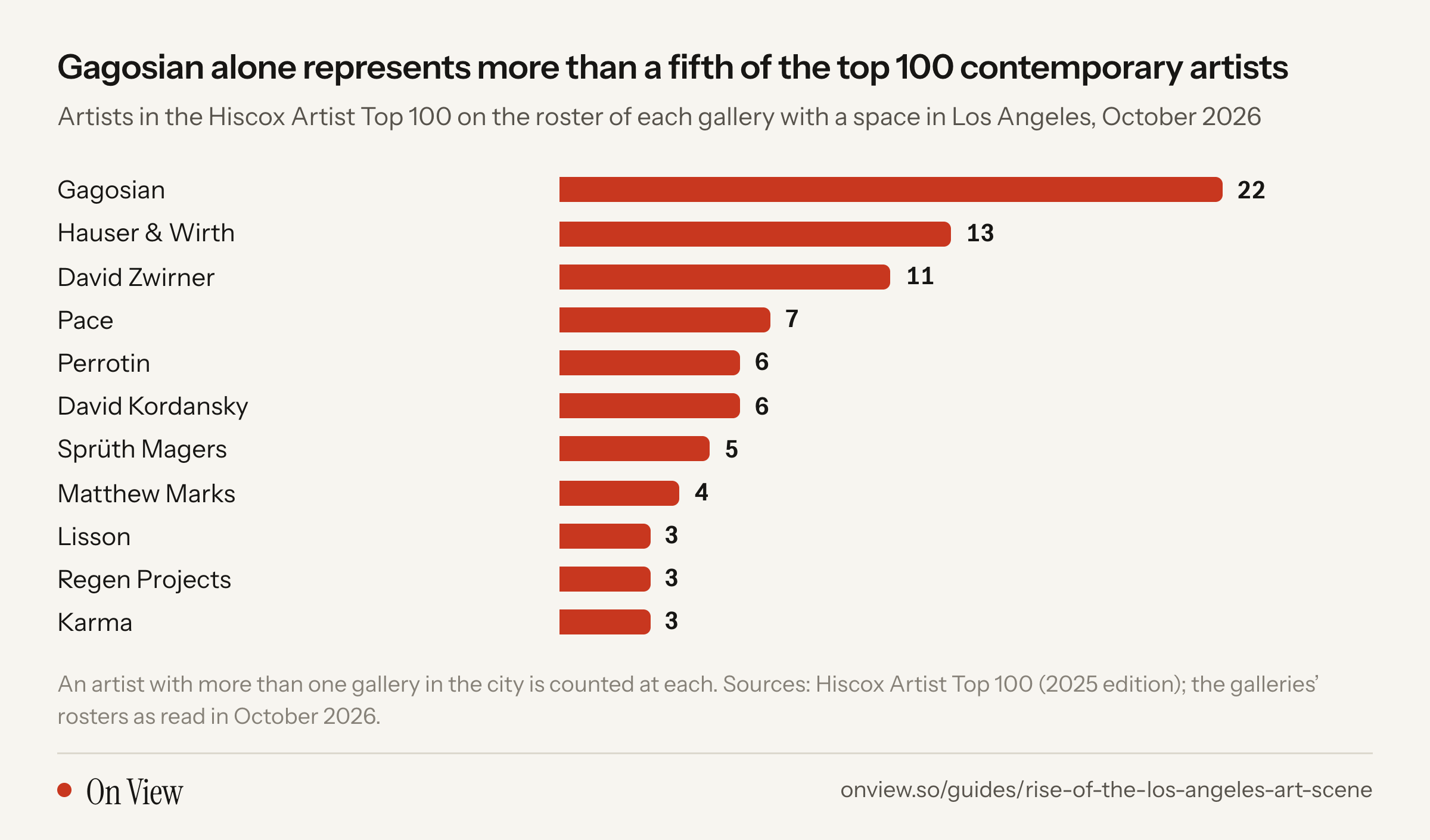
Having a gallery in a city is not the same as being shown in it. In the archives of 16 leading galleries and four museums, which list 2,262 exhibitions since 2000, the number of the Hiscox hundred given a solo show in Los Angeles in one year has never passed 11. It averaged 5 a year in the 2000s and 7 a year from 2016 to 2025. In 2025, when 72 of the hundred had a gallery here, three had a solo show: Yoshitomo Nara at Blum, in its last months, Richard Prince at Gagosian and Reggie Burrows Hodges at Karma. The galleries have brought their rosters to Los Angeles faster than they have brought the artists.
How many of the top 100 contemporary artists had a solo show in Los Angeles each year
Artists in the Hiscox Artist Top 100 with a solo exhibition opening that year at a leading gallery or museum
- At a gallery
- At a museum only
The numbers
| Year | At a gallery | At a museum only |
|---|---|---|
| 2000 | 4 | 1 |
| 2001 | 3 | 1 |
| 2002 | 2 | 0 |
| 2003 | 3 | 3 |
| 2004 | 5 | 1 |
| 2005 | 4 | 0 |
| 2006 | 3 | 1 |
| 2007 | 4 | 2 |
| 2008 | 5 | 3 |
| 2009 | 6 | 0 |
| 2010 | 3 | 2 |
| 2011 | 1 | 3 |
| 2012 | 9 | 1 |
| 2013 | 3 | 1 |
| 2014 | 6 | 0 |
| 2015 | 4 | 3 |
| 2016 | 8 | 3 |
| 2017 | 2 | 3 |
| 2018 | 6 | 3 |
| 2019 | 8 | 1 |
| 2020 | 4 | 0 |
| 2021 | 9 | 1 |
| 2022 | 6 | 1 |
| 2023 | 9 | 0 |
| 2024 | 6 | 1 |
| 2025 | 3 | 0 |
| 2026 | 7 | 0 |
2026 runs to October 3. Sources: Hiscox Artist Top 100 (2025 edition); the exhibition archives of the galleries and museums named in How we counted.
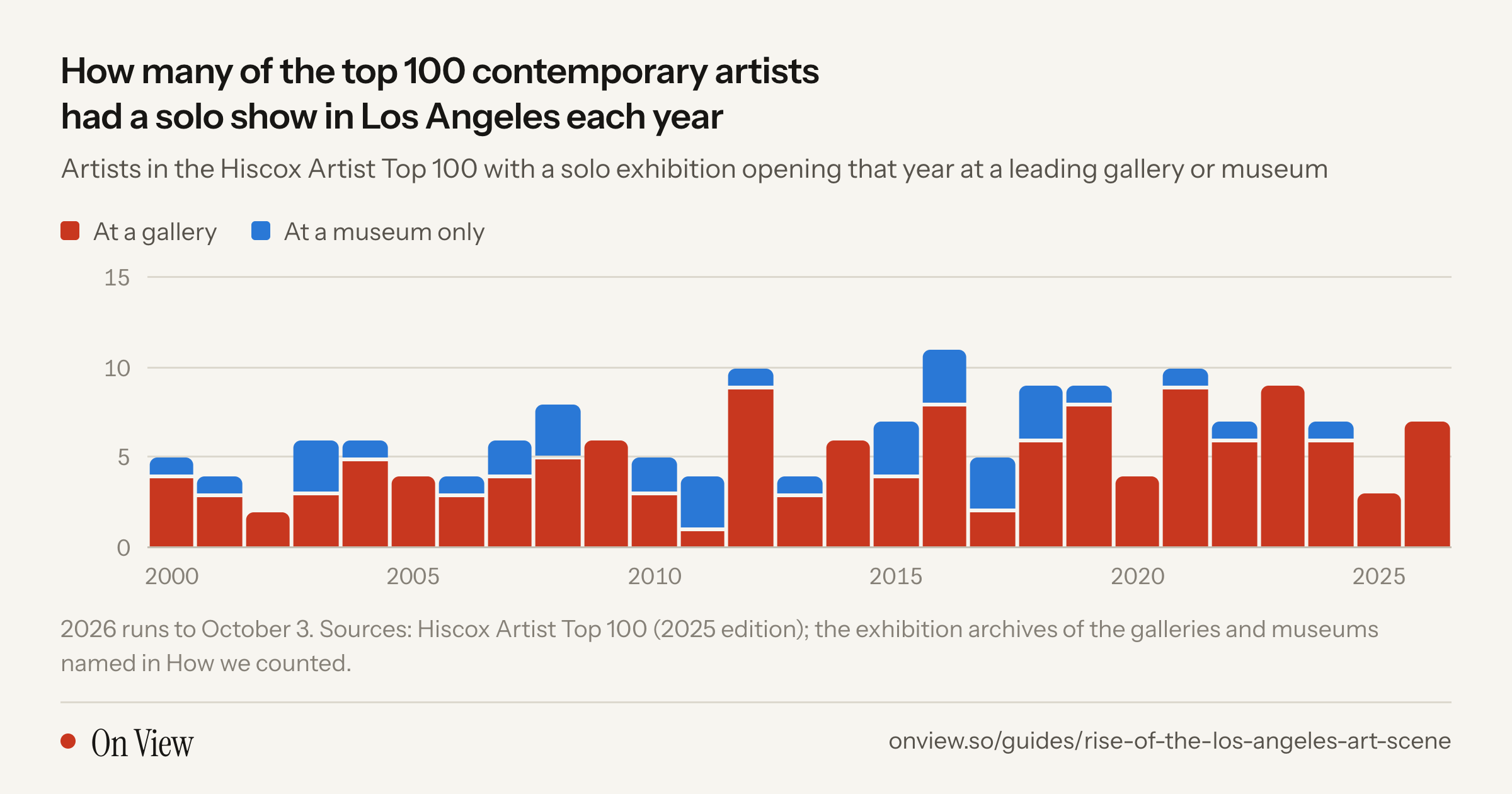
The three shown most often all made their careers in the city. David Hockney had 17 solo exhibitions in these archives, 12 of them at L.A. Louver; Ed Ruscha had 10 and Mark Grotjahn 9. Jonas Wood, who also works here, had 8, as did Glenn Ligon, Richard Prince and Takashi Murakami. In all, 59 of the hundred have had a solo show at one of these galleries or museums since 2000. The archives are incomplete for Hauser & Wirth and for LACMA, so these counts, too, are a floor.
The museums: $2.4 billion of building, most of it this year
The museums moved on a longer clock. LACMA opened on Wilshire Boulevard in 1965, MOCA downtown in the 1980s, the Hammer in 1990 and the Getty Center, at $1.3 billion, in 1997. The second wave began with The Broad, which opened on Grand Avenue in 2015 at a cost of $140 million, charged nothing, and counted 820,000 visitors in its first year. The Hammer had dropped its admission charge in 2014 and MOCA did in 2020, which with the Getty made four free museums; The Art Newspaper called Los Angeles the country’s free museum capital.
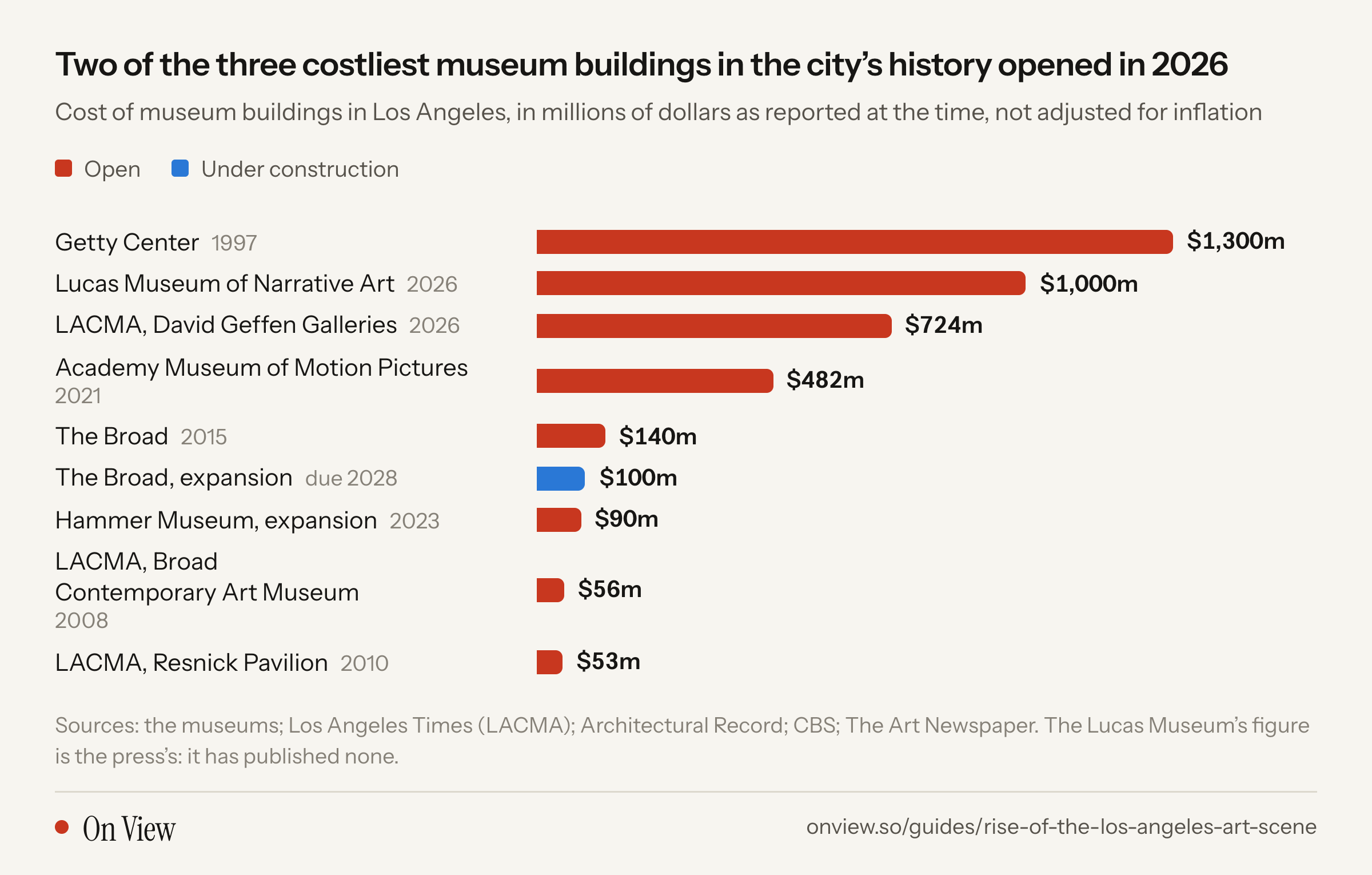
Then came 2026. In April LACMA opened the David Geffen Galleries, Peter Zumthor’s building across Wilshire Boulevard: 347,500 square feet, 110,000 of them galleries, at a cost the Los Angeles Times put at $723.8 million. In June Dataland, a museum of art made with artificial intelligence, opened downtown. On September 22 the Lucas Museum of Narrative Art opened in Exposition Park, with 300,000 square feet and a price the press gives as $1 billion; the museum has published none. With the Academy Museum (2021, $482 million) and the Hammer’s expansion (2023, about $90 million), the buildings opened since 2015 cost about $2.4 billion. The Broad is adding $100 million more, for 2028.
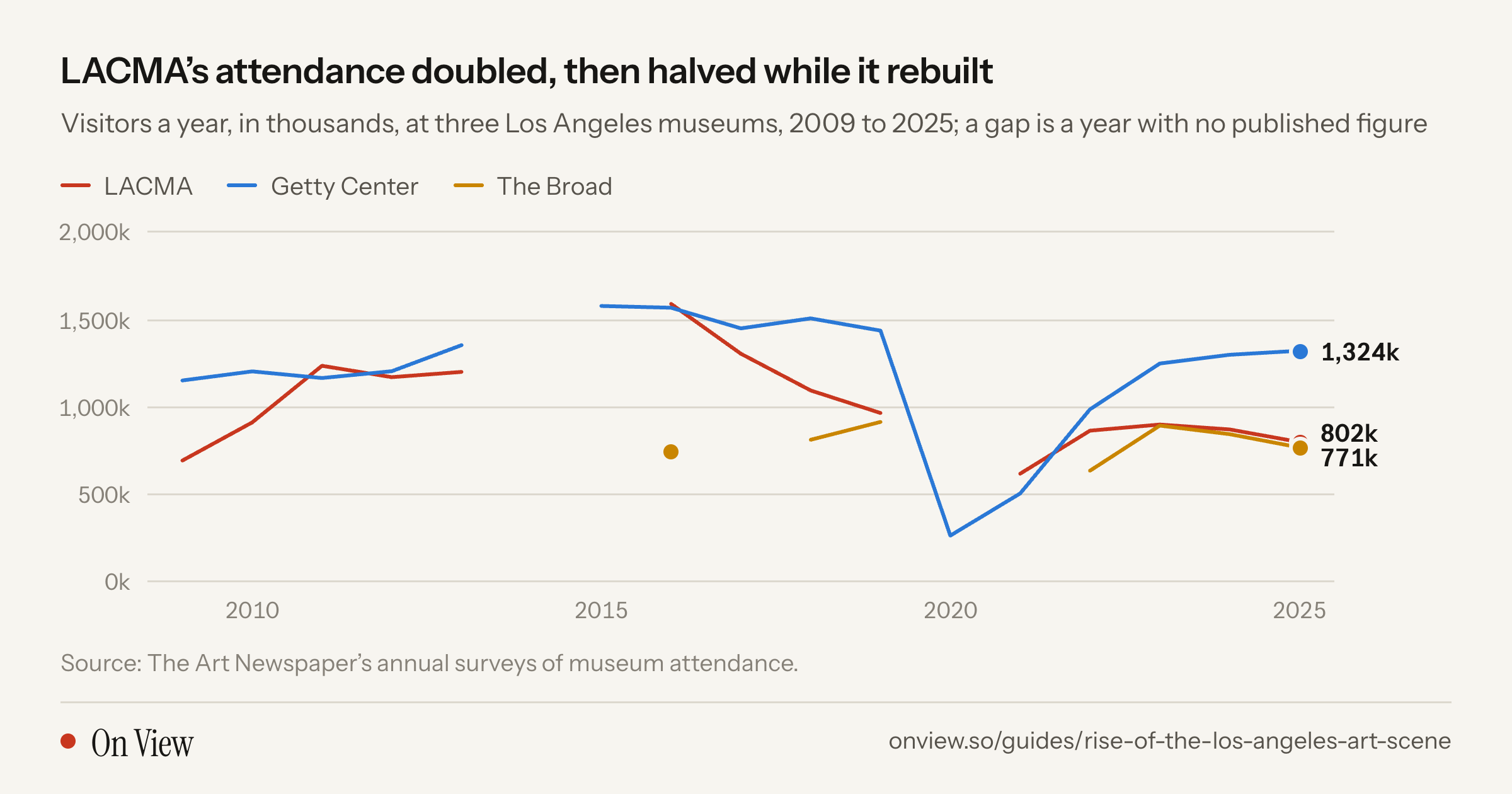
Attendance has not kept pace with the building, not yet. LACMA’s rose from 700,000 in 2009 to 1.6 million in 2016, then fell as its old buildings came down: 802,000 in 2025, its lowest outside the pandemic since 2009. The Getty Center, at 1.3 million, is close to its level before 2020, and The Broad drew 771,000. The first full year of the Geffen Galleries will be 2027, the year the Getty Center is to close for a renovation of about twelve months.
LACMA’s attendance doubled, then halved while it rebuilt
Visitors a year, in thousands, at three Los Angeles museums, 2009 to 2025; a gap is a year with no published figure
- LACMA
- Getty Center
- The Broad
The numbers
| Year | LACMA | Getty Center | The Broad |
|---|---|---|---|
| 2009 | 696k | 1,154k | – |
| 2010 | 914k | 1,206k | – |
| 2011 | 1,238k | 1,168k | – |
| 2012 | 1,173k | 1,207k | – |
| 2013 | 1,203k | 1,356k | – |
| 2014 | – | – | – |
| 2015 | – | 1,580k | – |
| 2016 | 1,592k | 1,570k | 753k |
| 2017 | 1,307k | 1,452k | – |
| 2018 | 1,097k | 1,509k | 815k |
| 2019 | 968k | 1,439k | 917k |
| 2020 | – | 267k | – |
| 2021 | 621k | 508k | – |
| 2022 | 867k | 989k | 638k |
| 2023 | 902k | 1,251k | 896k |
| 2024 | 874k | 1,301k | 847k |
| 2025 | 802k | 1,324k | 771k |
Source: The Art Newspaper’s annual surveys of museum attendance.
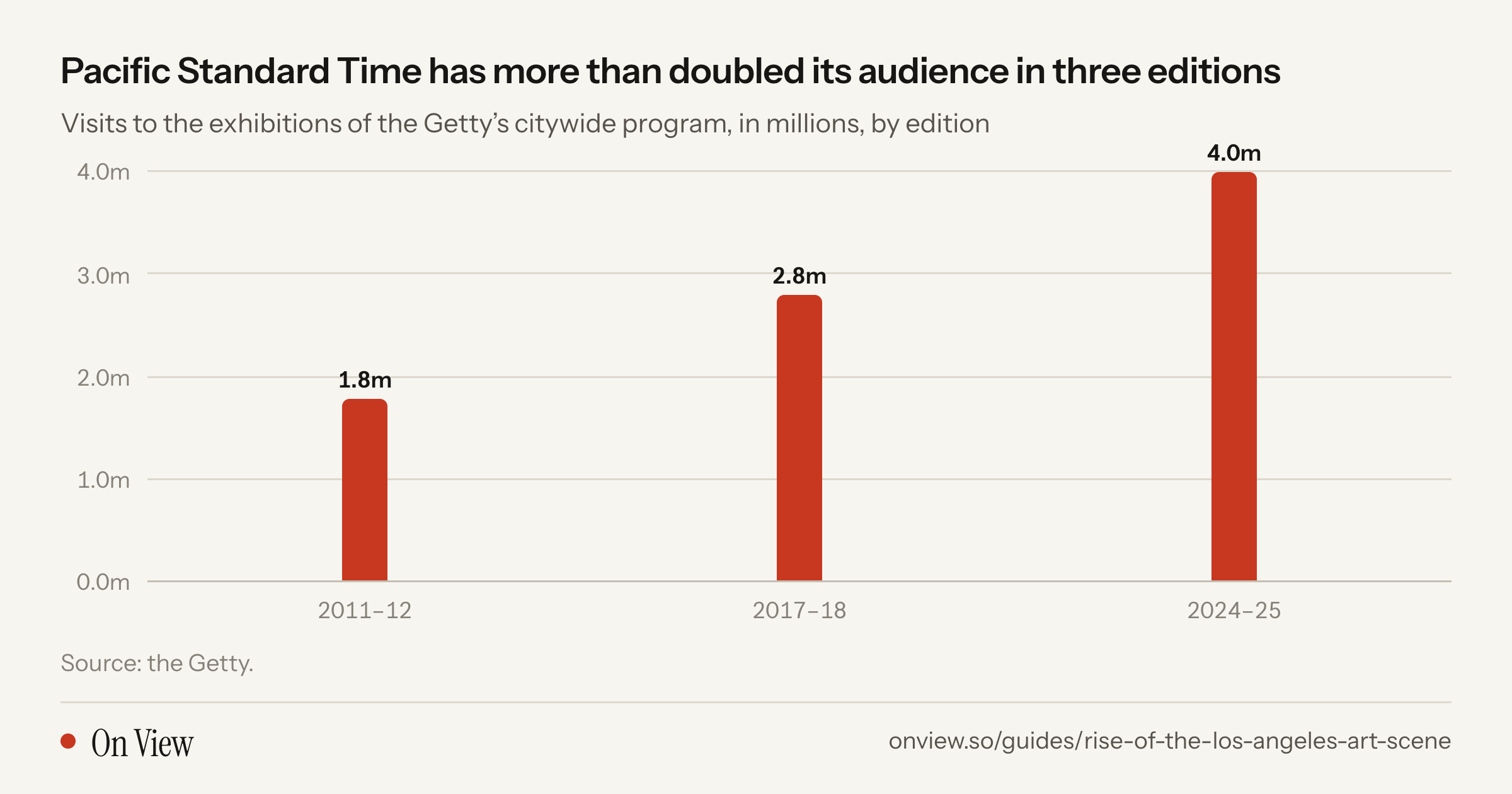
The Getty’s Pacific Standard Time may be the clearest sign of scale. The first edition, in 2011 and 2012, linked 68 exhibitions on art in Los Angeles from 1945 to 1980 and counted about 1.8 million visits. The second, on Latin American and Latino art, counted nearly 2.8 million in 2017 and 2018, and the third, on art and science, 4 million in 2024 and 2025.
Pacific Standard Time has more than doubled its audience in three editions
Visits to the exhibitions of the Getty’s citywide program, in millions, by edition
The numbers
| Edition | Visits, millions |
|---|---|
| 2011–12 | 1.8m |
| 2017–18 | 2.8m |
| 2024–25 | 4.0m |
Source: the Getty.
The market: New York prices, and a fair of its own
Los Angeles makes the art and New York sells it. Of the 37 auction records for Los Angeles artists that we could confirm, 28 were set in New York and none, as far as we can find, in Los Angeles. Christie’s opened a Beverly Hills flagship in 2017 and Phillips a West Hollywood gallery in 2022, both to show work that will be sold elsewhere; of the international houses only Bonhams lists an auction room in the city, on Sunset Boulevard.
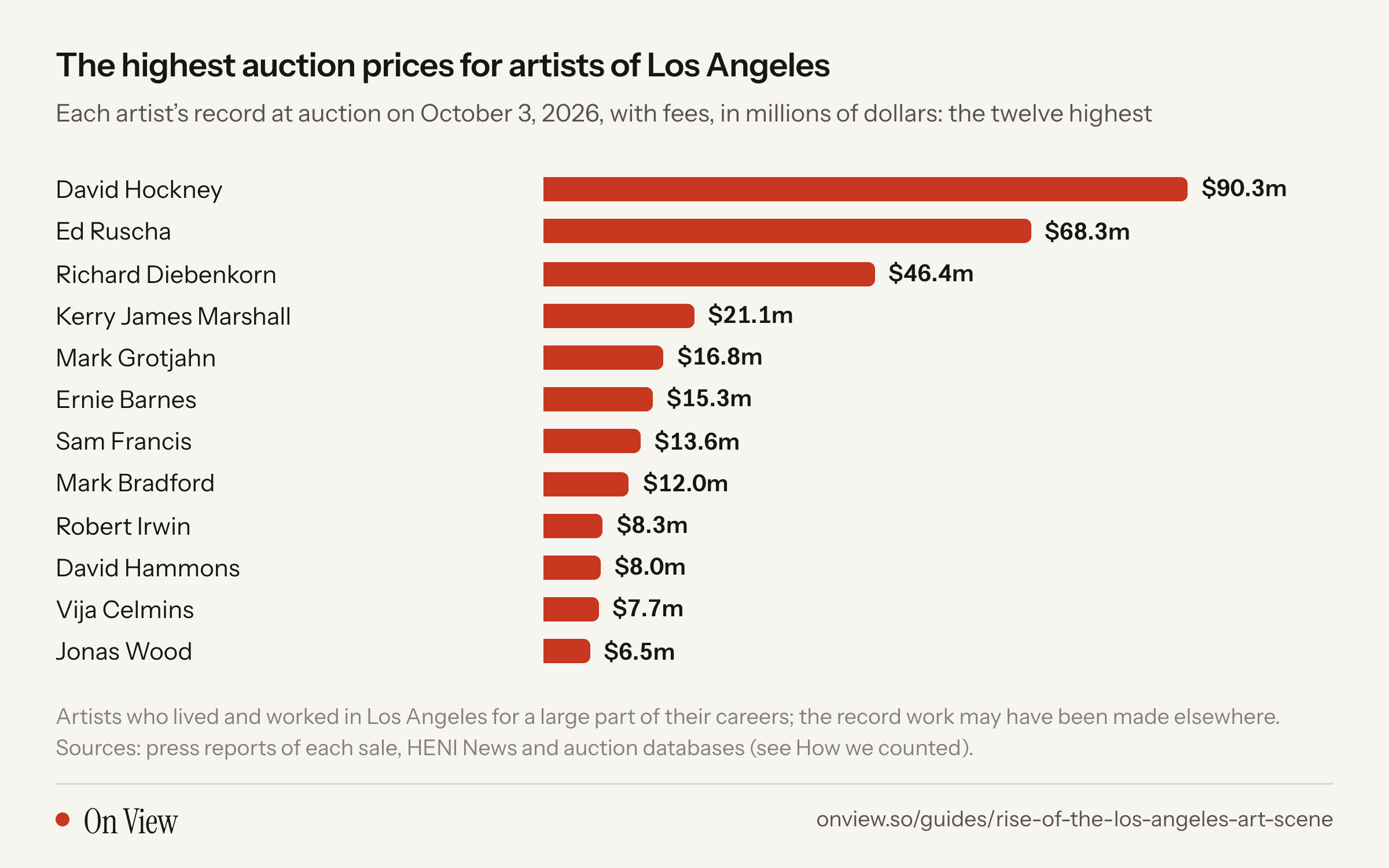
The prices themselves have risen with the city’s standing. Ed Ruscha’s record went from $30.4 million in 2014 to $52.5 million in 2019 and $68.3 million in 2024, for Standard Station, Ten-Cent Western Being Torn in Half, a painting of 1964. David Hockney’s Portrait of an Artist (Pool with Two Figures) made $90.3 million in 2018, then the most paid at auction for a work by a living artist. It shows the south of France; the most paid for one of his Los Angeles pictures is the $44.3 million that his double portrait of Christopher Isherwood and Don Bachardy made in November 2025. Hockney died in June 2026. Ernie Barnes’s The Sugar Shack, estimated at $150,000 to $200,000, sold for $15.3 million in 2022.
The younger painters’ prices record the boom and what came after. Jonas Wood’s record ($6.5 million) dates from 2021, and Christina Quarles’s ($4.5 million) and Njideka Akunyili Crosby’s ($4.7 million) from 2022; none has been beaten since. The largest sales by a Los Angeles collector were private: David Geffen sold a Pollock and a de Kooning in 2006 for a reported $140 million and $137.5 million.
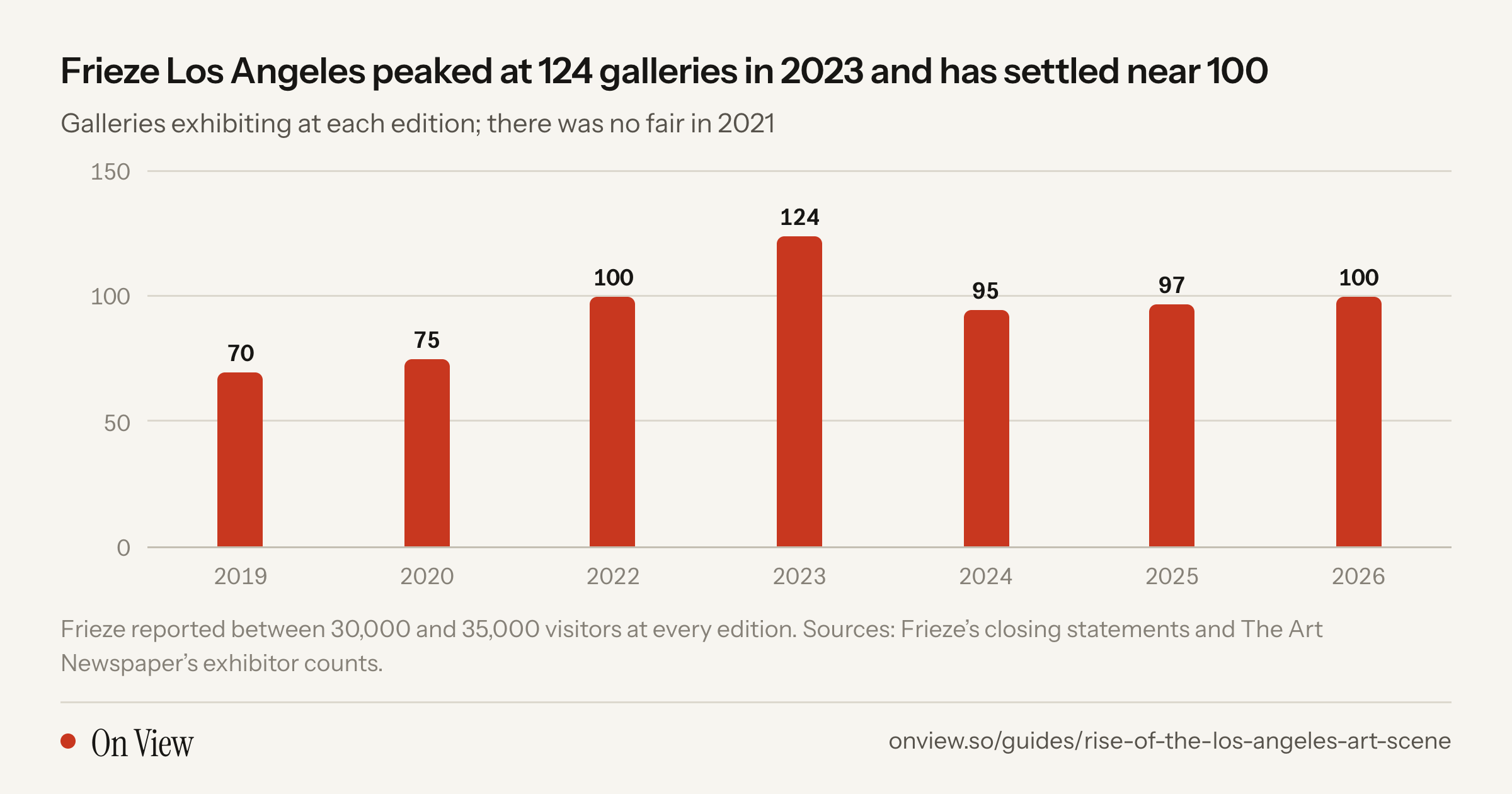
The fairs took three tries. Art Los Angeles Contemporary ran from 2010 to 2020; Paris Photo held three editions on the Paramount lot and cancelled the fourth. Frieze opened on the same lot in February 2019 with 70 galleries, moved to Beverly Hills in 2022 and to Santa Monica Airport in 2023, when it had 124, and has settled at about 100. Its attendance has stayed between 30,000 and 35,000 at every edition. The airport is due to close in 2028, so the fair will need another home.
Frieze Los Angeles peaked at 124 galleries in 2023 and has settled near 100
Galleries exhibiting at each edition; there was no fair in 2021
The numbers
| Year | Galleries |
|---|---|
| 2019 | 70 |
| 2020 | 75 |
| 2022 | 100 |
| 2023 | 124 |
| 2024 | 95 |
| 2025 | 97 |
| 2026 | 100 |
Frieze reported between 30,000 and 35,000 visitors at every edition. Sources: Frieze’s closing statements and The Art Newspaper’s exhibitor counts.
Beside the fairs of other cities, it is a small one. Art Basel had 290 galleries in Basel this June and 283 in Miami Beach last December; Frieze London and Frieze Masters, side by side in Regent’s Park, had more than 280 between them; the Armory Show in New York, which Frieze has owned since 2023, had about 230 in September. Frieze Los Angeles, with about 100, is a third the size of the largest. Of Frieze’s own fairs it is larger only than Frieze New York, which had 68 galleries in May; Frieze Seoul had more than 130.
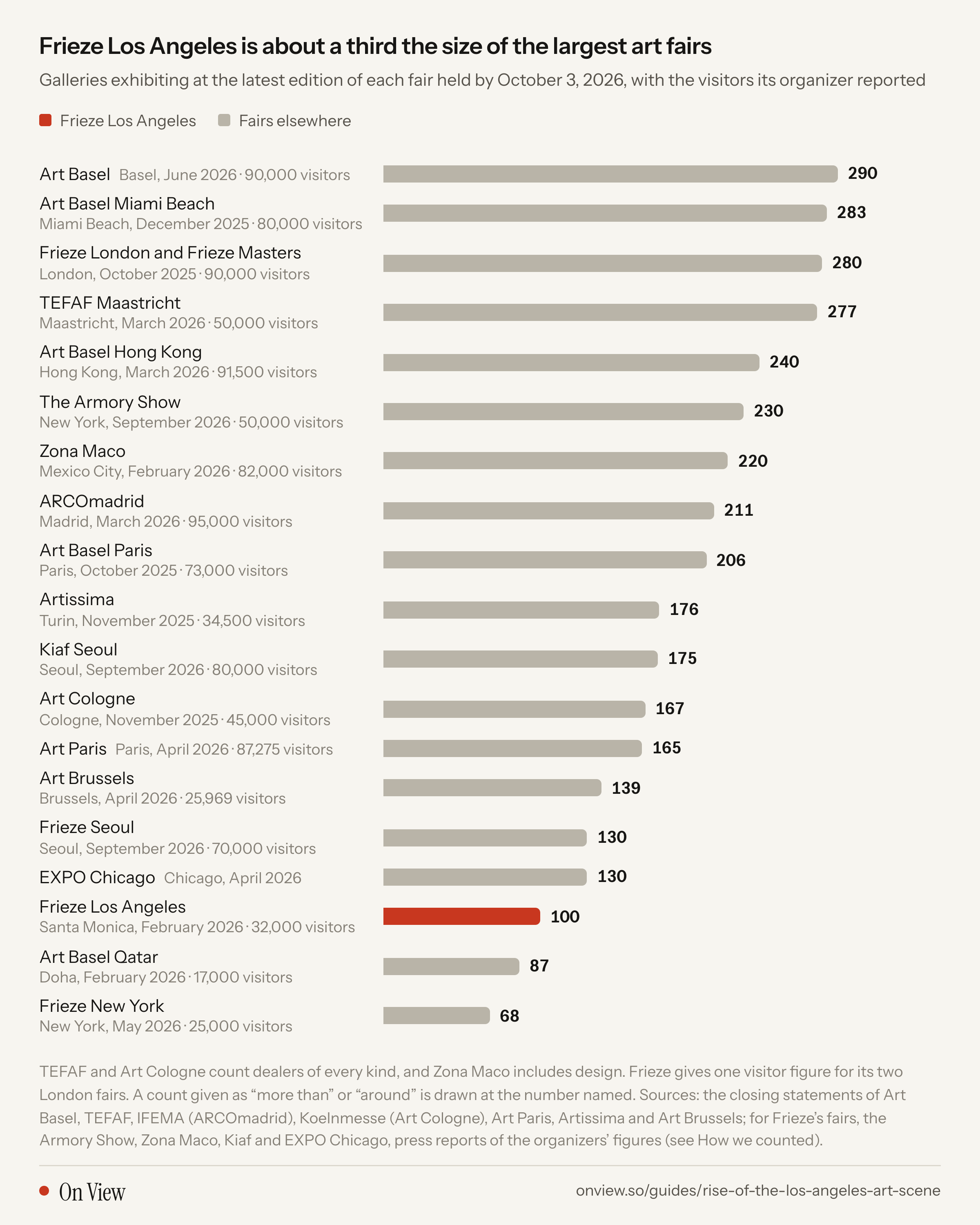
The crowds are in the same proportion: about 32,000 visitors in Los Angeles, against 90,000 at Art Basel, the same for the two London fairs together, 91,500 in Hong Kong and more than 70,000 in Seoul. Size is not the only measure of a fair, and a new one starts small: Art Basel’s newest, in Doha, opened this February with 87 galleries. But Frieze Los Angeles has had seven editions, and has not grown since 2023.
Where the galleries are now
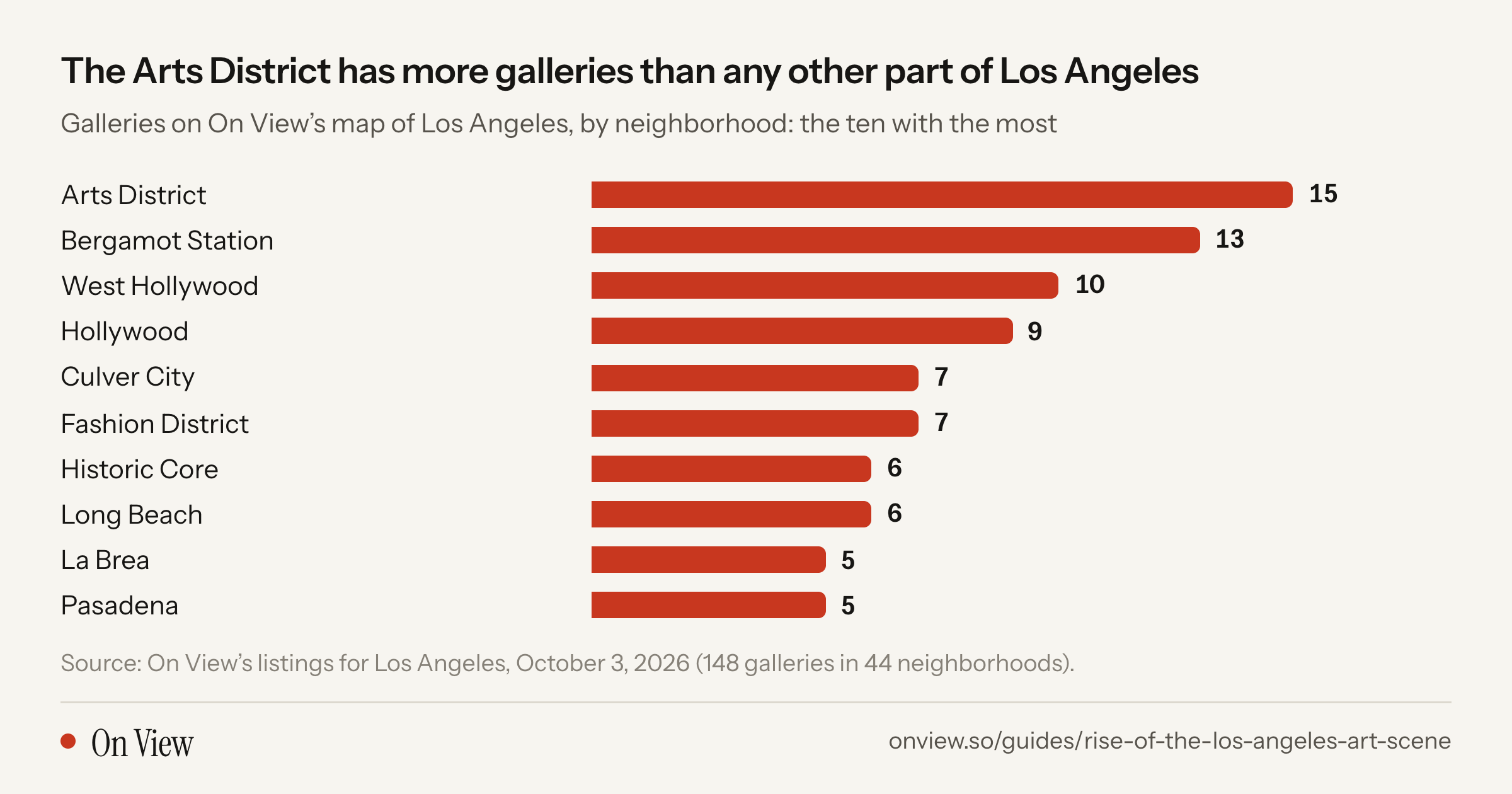
Where the galleries are has changed with each generation, and the list of districts is a history in itself. On On View’s map today the Arts District, downtown, has the most: 15, among them Hauser & Wirth, Night Gallery, François Ghebaly and Vielmetter. Bergamot Station in Santa Monica still has 13, though the city declared the site surplus land in February 2025 and gave its tenants about two years. West Hollywood has 10 and Hollywood 9. Culver City, which Blum & Poe made a gallery district in 2003, has 7 without it. Melrose Hill, which was not an art address before 2021, has David Zwirner and, by one count this spring, nearly twenty galleries around it.
What comes next is already on the calendar. Pace Prints is to open a workshop and gallery in Hollywood late this autumn. Frieze is listed for February 25 to 28, 2027. The Getty Center closes for its renovation in March 2027 and is to reopen in the spring of 2028, the year of The Broad’s expansion. There are fewer galleries than there were two years ago, and the museums have never had more room.
Frequently asked questions
When did the Los Angeles art scene begin?
As a gallery scene, in the 1950s on La Cienega Boulevard, where Felix Landau opened in 1951 and Ferus Gallery in 1957. Ferus gave Andy Warhol his first solo show of Pop paintings in 1962, and by July 1963 Time counted 22 exhibitions open on the boulevard on one Monday night. The county museum, LACMA, opened on Wilshire Boulevard in 1965, MOCA was founded in 1979, and the Getty Center opened in 1997.
Which major galleries have opened in Los Angeles, and when?
Gagosian opened in Beverly Hills in 1995, Matthew Marks in 2012, Sprüth Magers and Hauser & Wirth in 2016, Jeffrey Deitch in 2018, Karma in 2021, Pace in 2022, Lisson and David Zwirner in 2023 and Perrotin in 2024; all are open today. The city’s own leading galleries are older: Regen Projects dates from 1989, David Kordansky from 2003, François Ghebaly from 2009 and Night Gallery from 2010. The 12 best art galleries in Los Angeles describes them as they are now.
Which Los Angeles galleries have closed?
Since 2024: Nino Mier’s four Los Angeles galleries, Praz-Delavallade and Harper’s (2024); Blum, the former Blum & Poe, with Clearing, Tanya Bonakdar, The Hole and Southern Guild (2025); and Michael Werner, Marian Goodman and The Box (2026). L.A. Louver, in Venice since 1975, turned to private dealing in 2025, and Sean Kelly ended public exhibitions here that November. Earlier closures include Margo Leavin (2012, after 42 years), ACME. (2017) and Marc Foxx (2018).
How big is Hauser & Wirth in Los Angeles?
Its Arts District complex, a former flour mill at 901 East Third Street, was reported at 116,000 square feet when it opened as Hauser Wirth & Schimmel in March 2016, which makes it nearly four times the size of any other gallery in the city. Hauser & Wirth West Hollywood, opened in 2023 in a former car showroom, has about 6,000 square feet of exhibition space.
What is the most expensive work by a Los Angeles artist sold at auction?
David Hockney’s Portrait of an Artist (Pool with Two Figures), which sold for $90.3 million at Christie’s in New York in November 2018, then the most paid at auction for a work by a living artist; Hockney lived and worked in Los Angeles for decades, though that painting shows the south of France. The record for Ed Ruscha is $68.3 million, for Standard Station, Ten-Cent Western Being Torn in Half, at Christie’s in November 2024.
Which museums opened in Los Angeles in 2026?
Three. LACMA opened its David Geffen Galleries, designed by Peter Zumthor, to members in April and to the public on May 4. Dataland, a museum of art made with artificial intelligence, opened downtown on June 20. The Lucas Museum of Narrative Art opened in Exposition Park on September 22.
How many art galleries are there in Los Angeles?
There is no census. On View’s map lists 148 galleries and 25 museums in and around Los Angeles. Gallery Platform LA, the site of the galleries’ own association, lists 96 members, about 20 of them museums and non-profits; it listed 124 in March 2024.
How big is Frieze Los Angeles compared with other art fairs?
About a third the size of the largest. Frieze Los Angeles had about 100 galleries and 32,000 visitors in February 2026. Art Basel in Basel had 290 galleries and 90,000 visitors in June 2026, Art Basel Miami Beach 283 galleries in December 2025, and Frieze London with Frieze Masters more than 280 exhibitors and an estimated 90,000 visitors in October 2025. Among Frieze’s own fairs, only Frieze New York (68 galleries) is smaller.
When is Frieze Los Angeles?
In the last week of February. The 2026 fair ran from February 26 to March 1 at Santa Monica Airport, with about 100 galleries and 32,000 visitors, and the next is listed for February 25 to 28, 2027. The fair began in 2019 on the Paramount lot in Hollywood, missed 2021, and had its largest edition, 124 galleries, in 2023.
For what is on at these galleries and museums today, open the list of shows or the map; for a way in, read the 12 best art galleries in Los Angeles and the best gallery shows in Los Angeles this October. If you can correct or add to any figure here, write to us: the numbers will be revised as better ones come in.
How we counted
Galleries. We followed 60 galleries: 22 founded in Los Angeles and 38 that opened here as branches of galleries based elsewhere. A gallery counts as “from elsewhere” if its headquarters were in another city when it opened in Los Angeles County; Gagosian, founded here by Larry Gagosian, counts from 1995, when it returned from New York. Galleries that moved to the city outright, and partnerships with an outside dealer, are not counted as branches. Opening and closing years are those the galleries announced or the press reported. A gallery is counted in a year if it was open to the public at the end of it, and in 2026 if it was open on October 3. For eight galleries no closing date could be found (Gavlak, Ibid, Team, Karma International, Maccarone, Sargent’s Daughters, Shrine and Okey Dokey Konrad Fischer); they are counted to the end of the last year a source shows them open.
Floor space. Each figure is the one given when the space opened, by the gallery, its architect or the press, and is for the whole space where the source says which. Where sources differ we took the architect’s or the gallery’s. Gagosian’s 11,600 square feet in Beverly Hills is its architect’s two figures added together: 6,600 for the building of 1995 and 5,000 for the extension of 2010. A space that was later enlarged is counted once, at each size in turn. Ace Gallery is counted to the end of 2016, when a bankruptcy trustee took control of it. Spaces with no reported size are left out.
Top artists. The Hiscox Artist Top 100 (2025 edition, with research by ArtTactic) ranks artists by the 2024 auction sales, at Christie’s, Sotheby’s and Phillips, of unique works made after 2000. The Artprice100 is the portfolio of Artprice’s blue-chip index as composed on January 1, 2025: the hundred artists with the highest auction turnover from 2020 to 2024. An artist has “a gallery here” if a gallery with a space open in Los Angeles lists them, or their estate, on its roster; the rosters were read in October 2026, or for a closed gallery from the last copy in the Internet Archive. An artist is counted from the year they joined the gallery, where the gallery or the press gives one (46 of the 96 pairings of artist and gallery on the Hiscox list); failing that from the year of their first show with it (39); and otherwise for as long as the gallery has been here (11). No one is counted before the gallery had a space in Los Angeles, and three artists who left Gagosian and came back (Damien Hirst, Jeff Koons and Richard Prince) are not counted with it for the years between. Also counted, for 5 artists, are their years with a gallery here that no longer lists them, where a report gives those years; other past representation is not counted, so the early years are, if anything, understated.
Solo shows. Counted in the year they opened, from the exhibition archives of Gagosian, Regen Projects, Blum & Poe, David Kordansky, L.A. Louver, Matthew Marks, Sprüth Magers, Hauser & Wirth, Jeffrey Deitch, Karma, Pace, Sean Kelly, Lisson, David Zwirner, Marian Goodman and Perrotin, and of LACMA, MOCA, the Hammer and The Broad. Hauser & Wirth’s archive could be read only in the Internet Archive’s copies and has gaps, Karma’s begins in 2022, and about 35 of LACMA’s exhibitions, whose pages give no dates, are left out; the Getty and the Norton Simon are not included. The counts are a floor.
Museums and the market. Building costs are as reported when each opened and are not adjusted for inflation; the Lucas Museum has published none, and $1 billion is the figure the press uses. Attendance is from The Art Newspaper’s annual surveys. Auction prices include the buyer’s premium; an artist “of Los Angeles” is one who lived and worked here for a large part of a career, wherever the record work was made. Frieze’s exhibitor counts are those of its closing statements for 2025 and 2026, and The Art Newspaper’s for earlier years.
Other fairs. Each fair is counted at its latest edition held by October 3, 2026 (for the October and November fairs, that of 2025), by the number of galleries, exhibitors or dealers its organizer gave. Hong Kong’s, the Armory Show’s and EXPO Chicago’s are counts announced before the fair; no later one was found. The visitor figures are the organizers’ own and are not made alike: Art Basel counts visits by the day, ARCOmadrid’s 95,000 was its forecast on the closing day, and Kiaf and Frieze Seoul share a building and many of their visitors. Frieze’s own site could not be read, so its fairs’ figures are from press reports of its statements. Art Dubai, postponed and cut to 50 galleries in 2026, and India Art Fair, whose count includes institutions, are left out.
Limits. Several newspapers and magazines do not let their pages be read by a program (the Los Angeles Times, The New York Times, Artforum, ARTnews and Artnet among them), so this record leans on the galleries’, architects’ and museums’ own pages, the Getty’s finding aids, The Art Newspaper, Hyperallergic, Apollo, Cultured, LA Weekly and Architectural Record. The galleries and the neighborhoods on the last chart are those of On View’s listings on October 3, 2026.
Sources
- Hiscox Artist Top 100, 2025 edition (Hiscox and ArtTactic): the ranking of contemporary artists.
- The Artprice100 index (Artprice, April 2026): the hundred top-selling artists at auction, 2020 to 2024.
- Tim Blum is closing his gallery (The Art Newspaper, July 2025).
- Frieze Los Angeles 2026: preview (The Art Newspaper, February 2026): the closures of the year before.
- After the fires: Los Angeles galleries (Apollo).
- Anat Ebgi expands on Wilshire Boulevard (The Art Newspaper, September 2024): the galleries that closed second spaces.
- After a surge in Los Angeles galleries, competition for staff heats up (The Art Newspaper, February 2024).
- L.A. Louver to close its gallery space (Hyperallergic, September 2025).
- Gallery Platform LA: member galleries and its archived copies of 2023, 2024 and 2025.
- Gigantic Hauser Wirth & Schimmel gallery opens (Architectural Record, March 2016).
- How a shabby Hollywood intersection became a hot new art district (LA Weekly, August 2012).
- Monday night on La Cienega (Time, July 1963).
- The beginning: a life in art (Gagosian Quarterly, 2024): Larry Gagosian’s first galleries.
- Dwan Gallery records and the Margo Leavin and Nicholas Wilder records (Getty Research Institute, in the Online Archive of California).
- Peter Zumthor’s building for LACMA opens (Architectural Record, 2026): its size.
- LACMA spent nearly $724 million (Los Angeles Times, 2026): the cost of the David Geffen Galleries.
- The Lucas Museum of Narrative Art opens (the museum’s announcement).
- Los Angeles museums on the cusp of a new golden age (The Art Newspaper, February 2026).
- Pacific Standard Time: economic impact (the Getty, 2018), and its page on the 2024 edition.
- The Broad: 820,000 visitors in its first year (The Broad, September 2016).
- Ed Ruscha’s Standard Station sets his record (The Value, November 2024).
- David Hockney’s Portrait of an Artist sells for $90 million (CBS News, November 2018).
- Ernie Barnes’s The Sugar Shack sells for $15.3 million (Culture Type, May 2022).
- Frieze Los Angeles 2026 sees strong sales (ArtDependence, 2026): Frieze’s closing statement.
- Art Basel 2026 closes (Art Basel, June 2026), and its closing statements for Miami Beach, Hong Kong, Paris and Qatar.
- Frieze London 2025: what sold (Artlyst, October 2025): the two London fairs’ visitors.
- Korea’s art week ends (Seoul Economic Daily, September 2026): Frieze Seoul and Kiaf.
- TEFAF Maastricht 2026 concludes (TEFAF, March 2026).
- Global art sales fell 12% in 2024 (The Art Newspaper, April 2025, on the Art Basel and UBS report).
Published ; last revised on . The counts are On View’s own, from the sources named under each chart; the galleries and shows the text links to are as its listings for Los Angeles have them today. Every chart may be shared or embedded with a link back to this page.